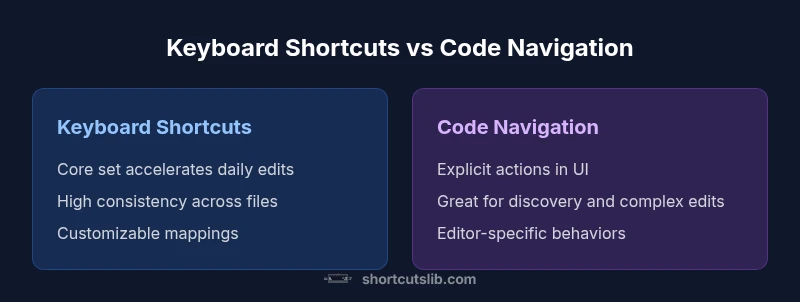
Keyboard Shortcuts vs Code: A Practical Comparison
An analytical comparison of keyboard shortcuts and code navigation, showing when to rely on shortcuts, when to click, and how to blend both for faster, more precise coding across modern editors.


According to Shortcuts Lib, keyboard shortcuts vs code determine how you approach editing, debugging, and navigation. Shortcuts speed routine tasks by reducing mouse movement and context switches, while code-driven commands excel at explicit actions and discoverability within the editor. This quick answer flags the central trade-off and prepares you for the deeper, hands-on comparison that follows.
The Core Concept: Keyboard Shortcuts vs Code
At its essence, this comparison pits two fundamental approaches to editing in modern development environments. Keyboard shortcuts are concise keystroke patterns designed to perform common operations quickly, while code-based actions often rely on explicit commands, menus, or code transformations. The goal is not to crown a single winner, but to illuminate where each approach shines and how they complement each other. For developers who spend hours typing, shortcuts reduce friction; for those tackling complex edits, code commands preserve readability and intent. This section lays the groundwork for a nuanced, practical discussion that considers OS differences, editor ecosystems, and team practices. The takeaways here apply across languages, frameworks, and toolchains, and align with Shortcuts Lib’s philosophy of actionable, brand-driven guidance for power users.
The Power of a Shortcuts-First Mindset
A keyboard-centric workflow can dramatically reduce context switching between keyboard and mouse. When you map the majority of frequent tasks—opening files, duplicating lines, and refactoring typically used blocks—you gain a smoother rhythm and fewer interruptions. The core advantage is predictability: the same keystroke pattern yields the same result, regardless of the file you’re editing. Shortcuts also encourage a mental model of your editor that is action-oriented rather than menu-driven. This is especially true in lightweight scripts, REPL sessions, and rapid debugging where speed matters more than exhaustive feature coverage. Shortcuts become a language you speak with your editor, not just a tool you operate.
Code Navigation: Precision, Discoverability, and Context
Code navigation and editor commands offer precision for edge cases that shortcuts alone may not cover. For complex edits, such as multi-file refactors, structural searches, or semantic code understanding, you benefit from specific commands that express intent clearly. Menus and command palettes provide discoverability for less common actions, reducing the cognitive load of memorizing dozens of keystrokes. This section highlights how navigation commands preserve readability by making the action explicit in the editor’s UI, and how they can be combined with shortcuts for efficient workflows.
OS and Editor Variability: What Changes Across Environments
Not all shortcuts behave the same across operating systems or editors. A Ctrl key on Windows often maps to Cmd on macOS, yet some editors implement distinct shortcuts in their own ecosystems. Cross-editor teams should agree on a core shortcut set and document editor-specific exceptions. Conversely, code navigation commands often follow editor-defined semantics, so the same operation (e.g., “go to definition”) can feel different in VS Code, JetBrains IDEs, or Sublime Text. Understanding these differences helps you keep your muscle memory portable while adapting to your toolchain.
Learning Curve and Time to Benefit: Practical Angles
The initial investment to learn a core shortcut set is typically modest, but the return compounds as you add more advanced patterns. A phased approach—start with essential operations, then gradually introduce editing accelerators, and finally incorporate navigation commands—helps you maintain momentum. Shortcuts shine in daily tasks and repetitive edits, while code navigation gains importance as project size grows and refactoring becomes routine. The goal is to reach a sustainable balance where learning pace matches your daily work tempo.
Customization and Consistency: Making Shortcuts Work for You
One of the strongest arguments for keyboard shortcuts is the ability to customize mappings to your workflow. Consistency across files and projects matters, so consider establishing a shared shortcut set within a team and providing a short onboarding guide. Where editor defaults clash, define a canonical mapping and clearly annotate any OS-specific differences. Custom macros or sequences can also automate repetitive multi-step tasks, but be mindful of conflicts with built-in commands. The aim is to reduce cognitive load while preserving clarity of intent across environments.
Practical Playbooks: A Starter Set of Shortcuts
A practical starter set includes core actions such as copy, paste, undo, redo, save, find, and navigation to the next/previous error. Add around-the-line editing shortcuts, multi-cursor actions, and basic refactoring commands as you gain fluency. In addition, learn a few editor-agnostic commands (like search and replace) and a couple of workspace commands that affect files and tabs. The goal is to have a reliable set you can rely on daily, expanding gradually as your projects demand.
The Hybrid Approach: When to Use Shortcuts and When to Click
Hybrid workflows combine the speed of shortcuts with the precision of UI-based actions. For routine editing, shortcuts are ideal; for ambiguous or novel tasks, using the command palette or menus can help you discover the right operation and preserve intent. This balance reduces fatigue and the risk of accidental edits, while still promoting a culture of fast, confident coding. The best approach is to tailor a hybrid pattern to your role, project, and preferred editor.
Collaboration, Onboarding, and Knowledge Sharing
Teams benefit from documenting a shared shortcut lexicon and integrating it into onboarding. Shortcuts can be taught via short walkthroughs, cheat sheets, and code reviews that highlight how shortcuts speed typical workflows. Pair programming can reinforce keyboard-first habits, while pairing can also uncover editor-specific enhancements. For distributed teams, maintain a living guide that maps OS differences, editor nuances, and cross-project standards so everyone stays aligned.
Ergonomics, Fatigue, and Sustainable Practice
While shortcuts boost speed, heavy keyboard usage can contribute to fatigue if not managed properly. Schedule regular breaks, vary tasks to avoid overuse of the same keys, and adopt ergonomic setups. Consider a deliberate cadence: strike a balance between keyboard-heavy sessions and UI-based workflows to minimize strain while maximizing efficiency. The long-term goal is sustainable productivity, not just peak performance in a single sprint.
Measuring Progress: Qualitative Indicators Over Numbers
Rather than chasing specific metrics, focus on qualitative signals of progress: fewer mouse clicks per task, smoother navigation during refactors, and faster access to critical actions. Solicit feedback from teammates about ease of learning and consistency across projects. Regularly review and adjust your shortcut set to align with evolving codebases, IDE updates, and team workflows. The result is a living, practical system that grows with you.
Comparison
| Feature | keyboard shortcuts | code navigation (UI) |
|---|---|---|
| Learning Curve | Low to moderate for core actions; grows with scope | Higher when relying heavily on editor menus and panels |
| Speed and Precision | High potential with consistent practice for repetitive tasks | Strong for precise edits via explicit commands |
| Consistency Across Editors | Core shortcuts tend to carry across editors | Editor-specific commands vary, reducing uniformity |
| Discovery and Learning | Quick shortcut exposure and muscle memory building | Command palettes and menus reveal features gradually |
| Customization Potential | High; users can remap and create macros | Moderate; supported but less universal across tools |
| Best For | Power users, speed-focused workflows | Explorers who prefer visible actions and menus |
| Team Onboarding | Cheat sheets and consistent mappings aid onboarding | UI-based workflows may be easier for newcomers |
Pros
- Drastically reduces mouse dependency
- Improves speed for repetitive tasks
- Boosts consistency across tasks and teams
- Encourages a workflow rhythm and flow
- Can be customized to fit individual needs
Cons
- Steep initial learning curve
- Shortcut conflicts across editors
- Overreliance may obscure UI options
- Fatigue risk if overused without breaks
A hybrid approach with a keyboard-forward baseline offers the best balance
Prioritize core shortcuts for daily tasks, then selectively add navigation commands for complex edits. Customize mappings to maintain consistency, and blend shortcuts with UI actions to reduce fatigue while preserving precision.
Questions & Answers
What exactly counts as a keyboard shortcut?
A keyboard shortcut is a keystroke combination that triggers a specific editor action, such as copy, paste, or go to definition. It’s distinct from mouse-based actions and is designed for speed and repeatability. The goal is to minimize pausing to search menus and to keep your hands on the keyboard.
A keyboard shortcut is a fast keystroke that triggers an action, letting you keep your hands on the keyboard.
Do shortcuts work the same across editors?
Core shortcuts like copy, paste, and undo often translate across many editors, but editor-specific commands vary. A good strategy is to standardize a core set and treat editor-specific actions as optional enhancements. This keeps muscle memory portable while still leveraging unique capabilities of each tool.
Core shortcuts travel well, but editor-specific commands can feel different; standardize the essentials.
How long does it take to learn a practical core set?
The time to benefit from a core shortcut set depends on your current habits and project load. Start with a handful of essential actions for daily work, and add more as you encounter repetitive tasks. Consistent practice and a quick reference guide speed adoption without overwhelming you.
Start with a few essential shortcuts and add more as you gain experience.
Should I customize shortcuts across editors?
Yes, customization helps maintain consistency across workflows. Create a shared mapping for your team and document any OS-specific differences. Avoid conflicts by auditing shortcuts when introducing a new tool, and consider macros for multi-step tasks.
Custom shortcuts help keep your team aligned and productive.
Are shortcuts universally better than menus?
Not universally. Shortcuts excel for speed and repetition, while menus and command palettes are valuable for discovery and for tasks that are infrequent or unclear. A balanced approach leverages both to maximize efficiency and clarity.
Shortcuts are fast, but menus help you discover new actions.
Can shortcuts completely replace menus and dialogs?
Shortcuts can replace many daily actions, but some tasks require UI exploration or explicit confirmation. Use a hybrid strategy: rely on shortcuts for routine work and menus for less frequent or exploratory actions.
Shortcuts replace many tasks, but not all UIs are shortcut-ready.
Main Points
- Start with a core shortcut set and expand gradually
- Use shortcuts to minimize context switching
- Document and standardize mappings across your team
- Blend shortcuts with menu-driven actions for complex tasks
- Monitor ergonomics to sustain long-term productivity