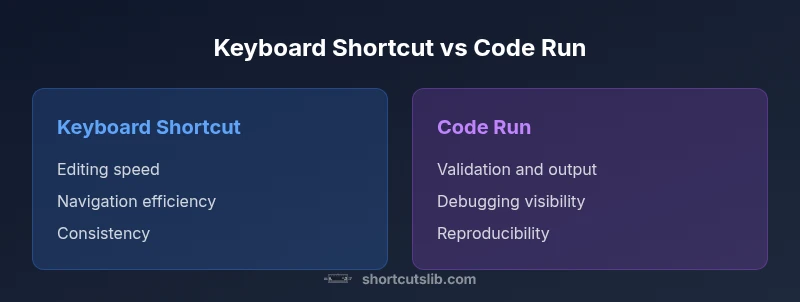
Keyboard Shortcut vs Code Run: A Practical Comparison
An analytical, side‑by‑side look at keyboard shortcuts versus code run actions. Learn when to rely on quick keybindings and when to execute code for validation, with practical guidance for teams and individuals.


TL;DR: Keyboard shortcuts excel at speed and consistency for repeated tasks, while executing code via Run commands offers clearer control and error handling for complex workflows. For most daily IDE tasks, prioritize keyboard shortcuts to accelerate coding, but reserve code-run actions for debugging, builds, and experiments to avoid misfires. That keeps your flow clean.
Overview: keyboard shortcut vs code run in daily workflows
For developers and power users, the choice between using a keyboard shortcut and triggering a code run command frames how we interact with our tools. The phrase keyboard shortcut vs code run captures a fundamental tension: do you rely on quick, muscle-memory actions that speed up routine work, or do you escalate to explicit run commands that verify behavior and produce artifacts? According to Shortcuts Lib, mastering a compact set of reliable keyboard shortcuts is a cornerstone of high productivity in modern IDEs and editors. Shortcuts reduce context switching and keep your hands on the keyboard, which correlates with faster iteration. Meanwhile, code run actions are essential when you need to test, build, or validate a feature in an environment that mirrors production. In this article we compare the two approaches across speed, reliability, learning curve, and real world use cases. We also discuss how teams can balance both for sustainable workflows.
Defining the actions: what constitutes a keyboard shortcut vs a Run command
A keyboard shortcut is a key combination that triggers a predefined command within your editor or OS. A Run command is an explicit action that executes code, scripts, or tasks and often produces output or artifacts. The key distinction is intention and scope: shortcuts aim for quick edits and navigation; Run commands emphasize execution results and state changes. This distinction matters across languages and toolchains because some environments map Run to build, test, or deploy steps, while shortcuts map to editing, search, or refactoring actions. Understanding the scope helps you design workflows that minimize friction and maximize reliability. For many developers, a typical arrangement is to reserve shortcuts for editing tasks and use Run for validation and automation. When you mix both without discipline, you risk context switching that slows you down rather than speed you up.
When shortcuts win: speed, flow, and muscle memory
Speed is the most obvious benefit of keyboard shortcuts. In a typical coding session you might navigate files, switch tabs, jump to a definition, and format code with combinations that feel like an extension of your fingers. Shortcuts reduce the need to reach for a mouse, decreasing cognitive load and allowing you to stay in a deep work state. The real power comes from consistency: a small, stable set of shortcuts applied uniformly across files and projects yields predictable outcomes. For daily tasks such as editing, commenting, and refactoring, keyboard shortcuts often deliver the fastest results and improve your overall rhythm. If your toolchain supports customizable keymaps, you can tailor a concise suite of commands to fit your personal mental model and reduce error rates over time.
When code runs win: verification, debugging, and repeatable builds
Code run actions are essential when you need to verify behavior or reproduce results. Running code in a controlled environment provides feedback through logs, tests, and outputs that you can rely on for debugging. Run commands also enable automation, such as one-click builds or CI pipelines, ensuring that changes behave as expected across environments. In complex projects, relying solely on shortcuts would hide problems that only appear during execution. The clarity of a run output helps you locate failures more efficiently and ensures you are validating the exact state of your program. For experiments, performance profiling, and continuous delivery, code run is an indispensable tool in the toolbox.
Learning curve and cognitive load
Learning curves differ notably between the two approaches. A well-chosen core set of keyboard shortcuts can deliver fast wins after a period of deliberate practice, but building that muscle memory takes time. The initial investment is higher, yet the payoff is a lighter cognitive load during editing and navigation. Run commands, by contrast, require familiarity with the toolchain, flags, and environment setups. Once learned, Run commands become highly reliable and repeatable, crucial for debugging sessions and reproducible builds. In practice, most teams benefit from a blended approach: shortcuts for editing and quick navigation, Run for verification and automation. This balance reduces fatigue and mitigates risk, especially on larger projects.
Environment and toolchain considerations
The effectiveness of keyboard shortcuts and Run commands often depends on the environment. In lightweight editors, shortcuts may control nearly all editing tasks, while in full IDEs you might rely on a mix of shortcuts and Run actions for compilation, testing, and deployment. Terminal users may leverage Run equivalents for scripting and batch jobs, while GUI-centric environments emphasize discoverability and keyboard maps. Platform differences matter too: Windows, macOS, and Linux all map certain shortcuts differently, which can create cross-platform friction if teams do not standardize. When evaluating a setup, consider your typical tasks, team preferences, and the availability of consistent keybindings across the full toolchain.
Customization, macros, and automation
Customization is where keyboard shortcuts unlock deeper productivity. Many editors support macro recording, multiple-key chords, and context-sensitive bindings that adapt to the current file type or project. Macros allow you to chain several editing actions into a single keystroke, dramatically reducing repetitive work. Automation extends beyond shortcuts through task runners, scriptable build steps, and CI pipelines that execute code runs automatically. Integrating both approaches—robust shortcuts for editing and scripted runs for validation—often yields the most resilient workflow. When designing macros and bindings, document them and keep a small, stable set to avoid conflicts and confusion.
Best practices for teams and onboarding
Teams benefit from shared conventions that reduce onboarding time and prevent conflicts. Start by identifying a core shortcut set for common workflows and document expected behaviors. Encourage contributors to map one or two project-specific shortcuts rather than rewriting entire toolchains. Establish a policy for run commands, including which actions should be bound to keyboard-driven triggers and when to rely on explicit commands in comments or README files. Regular audits of keybindings prevent bloat and ensure accessibility for new members. Collect feedback and adjust bindings to minimize cognitive load while preserving speed and reliability.
Practical decision framework: choosing between keyboard shortcut and code run
A practical framework helps decide which approach to favor in given moments. If speed and focus are critical, lean on keyboard shortcuts for editing, navigation, and quick formatting. If correctness, reproducibility, or debugging are paramount, switch to Run commands and capture outputs for inspection. Consider context: small edits in a running session vs large changes that affect a build or deployment. For teams, establish a lightweight governance model that documents when to prefer shortcuts and when to trigger explicit runs. Finally, measure outcomes: time to complete repetitive tasks, error rates, and onboarding time. These metrics guide future refinements and keep the workflow efficient.
Common pitfalls and how to mitigate them
Pitfalls include shortcut conflicts, over-reliance on automation, and inconsistent run environments. Conflicts occur when system-level shortcuts collide with editor bindings; mitigate by choosing a non-overlapping, documented set. Over-reliance on shortcuts can obscure errors if not paired with regular run-based verification. Maintain a policy to occasionally test code via explicit runs to ensure behavior aligns with expectations. Inconsistent environments undermine the reliability of Run actions; standardize shells, paths, and tool versions across the team. Document changes, run periodic training sessions, and use version-controlled configurations to keep everyone aligned.
Comparison
| Feature | keyboard shortcut | code run |
|---|---|---|
| Best use case | Fast editing/navigation and refactoring | Validation, builds, and execution across environments |
| Speed/latency | Near-instant after learning; muscle-memory driven | Dependent on environment; execution may introduce delay |
| Learning curve | Moderate to high; requires deliberate practice | Moderate; demands toolchain familiarity |
| Reliability | High with consistent bindings; risks from conflicts | High for reproducible results when configured well |
| Automation potential | Macros and chained shortcuts for editing tasks | Scripts, pipelines, and CI for automation |
| Best for teams | Editors and fast coding teams | QA, build, and release teams |
Pros
- Significant speed gains through muscle memory
- Reduced context switching during editing
- Improved consistency across files and projects
- Potential to automate repetitive editing tasks
- Lower fatigue during long coding sessions
Cons
- Learning curve to build a robust shortcut set
- Conflicts with global or app-level shortcuts
- Modal contexts may hide errors during editing
- Overreliance can neglect code correctness verification
Adopt a balanced approach: lean on keyboard shortcuts for editing and navigating, and use code run for validation.
Keyboard shortcuts boost speed and consistency for editing tasks, while code run provides verification through execution. The Shortcuts Lib team recommends pairing the two: rely on shortcuts for rapid editing and Run for validation and builds to maintain reliability.
Questions & Answers
What is the practical difference between a keyboard shortcut and a code run?
A keyboard shortcut triggers editing or navigation commands quickly within your editor, while a code run executes code, producing outputs or artifacts for validation. Shortcuts speed up daily tasks, whereas code runs verify correctness and reproduce results.
Shortcuts move you faster while editing, and running code checks that what you edited behaves as expected.
When should I favor keyboard shortcuts over running code?
Use keyboard shortcuts for routine editing, navigation, and formatting to maintain flow. Reserve code runs for verification, debugging, and builds where observable outputs are needed.
Prefer shortcuts for quick edits; run code when you need to check behavior or produce results.
Can keyboard shortcuts be customized for development workflows?
Yes. Most IDEs support customizable keymaps and macros. Customize to fit your mental model, but keep a small, stable core to avoid conflicts and confusion.
You can tailor keybindings, but keep them simple and consistent.
Are there risks in binding shortcuts to code run actions?
Binding runs to shortcuts can cause accidental executions or conflicts with other apps. Separate editing shortcuts from critical run commands and include safeguards like confirmation prompts for risky actions.
Be careful not to trigger runs by mistake; keep a safeguard in place.
Do shortcuts help with debugging workflows?
Shortcuts can speed up navigation and quick checks during debugging, but you still rely on Run outputs and breakpoints to locate and fix root causes.
Shortcuts speed things up, but debugging still needs code runs and logs.
What is best practice for onboarding teams to both approaches?
Teach a concise core shortcut set first, document standard Run commands, and schedule periodic reviews to adjust bindings as projects evolve.
Start with the basics, document them well, and review regularly.
Main Points
- Identify a core shortcut set and standardize it
- Reserve Run actions for validation and builds
- Document bindings to avoid conflicts
- Incorporate macros to automate repetitive edits
- Balance speed with reliability in team practices