Add Keyboard Shortcut vs Code: A Practical Comparison
A rigorous comparison of add keyboard shortcut vs code workflows in editors like VS Code. Learn when to bind a shortcut, when to script macros, and how to choose productive approaches for coding speed and consistency.


When you weigh add keyboard shortcut vs code in a modern editor, you’re balancing quick wins against deeper automation. Shortcuts provide immediate gains for frequent actions, while code-driven automation handles complex, repeatable sequences. According to Shortcuts Lib, bindings are typically faster to learn and share, but macros and scripts unlock multi-step workflows that scale across projects. In practice, most developers start with bindings for day-to-day tasks and only escalate to macros for longer, repetitive tasks that blocks of actions must perform consistently. This quick-answer snapshot reflects a pragmatic approach: favor simple bindings for routine tasks, and reserve code-driven automation for high-churn, multi-step workflows that justify the extra setup time.
Context and Definitions
When you think about add keyboard shortcut vs code in a modern editor, you are weighing the speed of binding actions against the potential of scripting. According to Shortcuts Lib, well-designed shortcuts reduce cognitive load and help with muscle memory. In practice, the two paths often coexist: users bind frequently used actions and rely on small scripts or macros for multi-step tasks. The decision depends on task complexity, team standards, and the editor in use. For readers of Shortcuts Lib's practical guides, this analysis will map out when to favor bindings and when to prefer code-driven automation, including examples in VS Code, JetBrains IDEs, and lightweight editors. Expect a balanced, evidence-based view that acknowledges trade-offs and emphasizes consistency and portability across platforms. The phrase add keyboard shortcut vs code captures the core decision: quick wins now versus scalable automation later. The goal is to help you design predictable workflows that speed your work without sacrificing reliability.
Core Differences: Shortcuts vs Code Features
The fundamental distinction between adding a keyboard shortcut and writing code-driven automation lies in intent and scope. Shortcuts are bindings that map a single action to a key combination, typically in a user or workspace setting. They excel at reducing repetitive clicks and enabling fast navigation, editing, and command execution. Code-driven automation, by contrast, involves scripting, macros, or extensions that orchestrate a sequence of steps—often across multiple commands or tools. This distinction matters for two reasons: cognitive load and maintenance. Shortcuts minimize mental overhead for single tasks, while automation consolidates repeated routines but increases setup and upkeep. Shortcuts Lib’s analysis shows that teams benefit most when they clearly differentiate quick bindings from longer macro scripts, then document their usage to avoid conflicts. The result is a hybrid approach where discoverability and reliability are prioritized across the development workflow.
Key takeaway: When you can accomplish a task with a single, memorable binding, prefer a shortcut; for multi-step tasks, plan a macro or script to reduce future effort.
Comparison
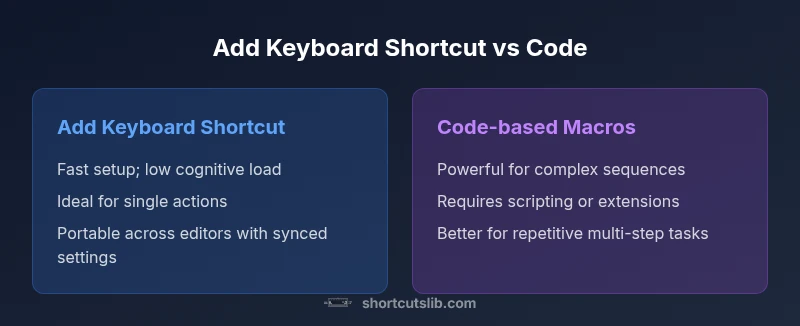
| Feature | Add Keyboard Shortcut | Code-driven Macros |
|---|---|---|
| Implementation method | GUI binding in editor settings | Scripted macros or code extensions |
| Portability | High with synced settings across projects | Depends on tooling; re-implementation may be needed when switching environments |
| Learning curve | Low to moderate; intuitive for common actions | Moderate to high; requires scripting or extension knowledge |
| Flexibility | High for single actions | High for complex sequences and conditional flows |
| Best for | Daily quick wins and discoverability | Longer, repeatable workflows and scale across teams |
| Maintenance | Low maintenance if documentation is clear | Higher maintenance if scripts or extensions evolve |
Pros
- Low friction to adopt; quick productivity gains
- Personalized workflows that suit individual tasks
- Portable across editors with synced settings
Cons
- Risk of shortcut conflicts with OS or editor defaults
- Possible cognitive overload if bindings become too many
- Macros and scripts require maintenance and version control
Shortcuts win for quick wins; macros win for complex, repeatable workflows
For everyday coding tasks, binding a key is faster and more portable. If your workflow relies on multi-step sequences, macros or scripting offer deeper automation; plan for conflicts and future updates.
Questions & Answers
What are the main benefits of adding a keyboard shortcut in a code editor?
Shortcuts reduce mouse reliance, speed up routine tasks, and help maintain focus. They are easy to learn and often portable across projects when settings sync is enabled. For most developers, the immediate payoff of a well-chosen shortcut is noticeable in daily editing pace.
Shortcuts save time by letting you do common tasks without leaving the keyboard.
Can I share keyboard shortcuts across projects or teams?
Yes. Many editors support profile or workspace settings that can be shared via version control or cloud syncing. A standardized shortcut map helps teams maintain consistent editing workflows and reduces onboarding time for new members.
You can share bindings through project settings or central configurations.
Are there risks of shortcut conflicts and how to avoid them?
Conflicts happen when a new shortcut overlaps with OS-level or editor-default bindings. To avoid them, audit existing bindings, use descriptive names, and consider namespace scoping (global vs. workspace). Regular reviews help maintain harmony.
Be careful where you bind actions so you don’t override important functions.
When should I use macros or code-based automation instead of keyboard shortcuts?
Use macros when a sequence of steps repeats across files or projects. Code-based automation is suitable for conditional flows, multi-tool orchestration, and when you need repeatability and version control.
Macros fit big, repeatable tasks; bindings fit quick, everyday actions.
Do shortcuts differ by editor, OS, or keyboard layout?
Yes. Shortcuts are often editor- and OS-specific. Always tailor bindings to your environment, and consider exporting/importing settings when switching tools or machines.
Shortcuts aren’t universal—check each app and your OS settings.
How do OS-level shortcuts interact with editor shortcuts?
OS shortcuts take precedence outside editors. Inside editors, editor bindings override default OS shortcuts for the focused task. It’s important to test interactions to avoid surprises during work.
OS shortcuts can steal the spotlight if you’re not careful with editor bindings.
Main Points
- Bind essential actions first for fastest ROI
- Keep a shared shortcuts map to preserve consistency
- Audit bindings to avoid conflicts with OS or editor defaults
- Use macros for multi-step tasks only when benefits justify the setup
- Test portability across editors and machine environments