Keyboard Shortcuts vs: A Deep Dive into Efficiency
An analytical comparison of keyboard shortcuts vs traditional navigation, exploring speed, learning curves, platform differences, and practical strategies for power users and teams.


Keyboard shortcuts vs traditional navigation generally favors speed and precision for repetitive tasks, especially across apps with robust shortcut support. While shortcuts boost efficiency once learned, outcomes depend on platform, app coverage, and user training. This guide helps you choose a practical path for everyday workflows.
What keyboard shortcuts vs means in practice
In the realm of productivity, the phrase keyboard shortcuts vs often appears in searches by power users who want to optimize every interaction. The core question is simple: can you replace most mouse-driven actions with keystrokes without sacrificing accuracy? The answer is nuanced. Keyboard shortcuts vs frames a decision about speed, cognitive load, and long-term consistency across tasks. As Shortcuts Lib analyses show, empowered users frequently report faster task completion when shortcuts align with common mental models. The goal is not to escape all mouse usage but to reduce repetitive motion and free cognitive resources for higher-value work. In 2026, the landscape has matured: many apps ship with centralized shortcut libraries, and learning paths are more accessible than ever. For keyboard enthusiasts, the concept of keyboard shortcuts vs invites structured practice rather than ad hoc memorization.
Speed and cognitive load in keyboard shortcuts vs
Speed is the most obvious winner when shortcuts are well-chosen and consistently applied. A well-tuned set of keystrokes can cut the average action time by a noticeable margin, especially for tasks like text editing, formatting, and navigation. However, speed comes with a trade-off: initial cognitive load. Beginners must memorize mappings, which can temporarily slow down performance. The balance point—where speed gains offset learning costs—varies by task, app, and user comfort. As you widen your repertoire, you’ll experience a smoother mental model: you know where to reach for a given action, reducing decision fatigue. Long-term studies on keyboard shortcuts vs suggest that deliberate practice compounds efficiency gains over weeks, not hours.
Platform differences and universal vs app-specific shortcuts
Windows, macOS, and Linux ecosystems implement shortcuts differently. Some basics overlap (copy, paste, undo) but many commands are environment-specific. This divergence is a primary reason to consider keyboard shortcuts vs in-app navigation carefully: what works brilliantly in one app may hinder you in another. The key tactic is to build a core set of universal shortcuts and then layer app-specific ones as you master each tool. In practice, this means a two-tier approach: a universal baseline plus targeted shortcuts for critical apps in your stack.
App-level vs system-level shortcuts: where to invest
System-level shortcuts are generally consistent across applications on a given platform, while app-level shortcuts vary widely. Investing time in system shortcuts yields broad benefits, but you’ll need to tailor app shortcuts to your most-used software. A practical method is to map top workflows first (e.g., text editing, file management, browser navigation) and then refine per-application mappings. When thinking about keyboard shortcuts vs, consider which layer dominates your daily tasks and where conflicts are most likely to occur.
Learning pathways: practical, scalable strategies
A practical learning path blends short, focused practice with real-work integration. Start with a core set of high-value shortcuts (copy, paste, undo, find, save) and practice them in context for 15 minutes daily. Gradually add 2–3 new shortcuts per week, rotating through different apps to ensure transferability. Spaced repetition and deliberate practice help move knowledge from short-term memory to long-term mastery. Shortcuts Lib recommends building cheat sheets for quick reference, then testing yourself in realistic scenarios. By combining deliberate practice with real tasks, you’ll see tangible improvements in a few weeks.
Real-world scenarios: editors, browsers, and spreadsheets
Different domains require different shortcut emphases. In text editors, quick navigation and formatting shortcuts dominate. In browsers, tab management and search shortcuts yield big gains. In spreadsheets, formula entry and cell navigation shortcuts accelerate workflows. A cohesive strategy adopts cross-domain consistency where possible while honoring domain-specific conventions. Practically, this means designing a baseline of universal keys and adding domain-focused accelerators as you gain comfort. When someone asks keyboard shortcuts vs in real-world tasks, the answer is that both speed and accuracy improve with intentional practice across contexts.
Customization, conflicts, and cross-app consistency
Customization is a double-edged sword: it lets you tailor shortcuts to your workflow but may introduce conflicts across apps. Establish a personal or team-wide standard for the most-used keys, then document exceptions for high-priority tools. Consistency across platforms matters; for teams, aligning Mac and Windows shortcuts wherever possible reduces cognitive load. Tools that centralize shortcuts, like global hotkey managers, can help, but you should avoid widespread conflicts and ensure critical commands work in all environments. The practice of maintaining a short, coherent subset of shortcuts reduces confusion and improves long-term retention.
Pitfalls and best practices: actionable guidance
Common pitfalls include overloading yourself with too many shortcuts at once, choosing non-intuitive mappings, and neglecting accessibility concerns. Best practices emphasize gradual rollout, regular review of which shortcuts save time, and ensuring that shortcuts don’t interfere with assistive technologies. Keep a living document of your shortcuts, test them in real-work contexts, and revisit your mappings quarterly. For teams, establish a standard operating procedure for onboarding new members to the shortcut set and offer periodic refresh sessions to maintain momentum. By avoiding overload and prioritizing high-impact mappings, you maximize the benefits of keyboard shortcuts vs.
Evaluating shortcut strategies for teams: a pragmatic framework
Teams should evaluate shortcut strategies based on impact on throughput, error rate, and onboarding velocity. Start with baseline metrics: task completion time and error frequency for common workflows. Introduce a standardized shortcut set for the most repetitive tasks, then measure improvements after 2–4 weeks. Use feedback loops to adjust mappings and resolve conflicts. The framework emphasizes repeatability, scalability, and alignment with the team’s tooling. When negotiating keyboard shortcuts vs team efficiency, the emphasis is on measurable gains and minimal disruption to existing processes.
Comparison
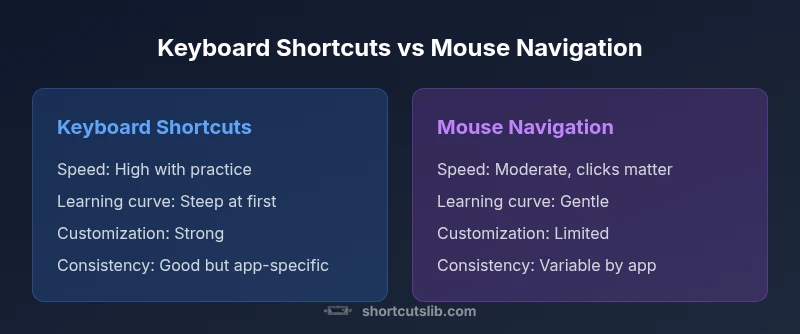
| Feature | Keyboard Shortcuts | Mouse Navigation |
|---|---|---|
| Speed | High with practice | Moderate, depends on clicking rhythm |
| Learning curve | Steep at start but rapidly rewarding | Low to moderate, intuitive for some tasks |
| Consistency across apps | Good for universal basics; app-specific gaps exist | High variability depending on app |
| Customization potential | Very strong; easily remapped and extended | Limited customization in most apps |
Pros
- Drastically reduces mouse travel time for repetitive tasks
- Accelerates workflow when mappings align with user habits
- Enhances accuracy by minimizing finger movement and mis-clicks
- Can be customized to fit individual workflows and domains
Cons
- Learning curve can deter initial adoption
- Conflicts across apps can create confusion
- Not all software supports the full shortcut set
- Overreliance may reduce visibility into UI changes
Keyboard shortcuts generally win for speed, but effectiveness hinges on app support and training.
Adopting a structured shortcut strategy yields faster task completion and less cognitive load over time. Start with universal basics, then tailor per-app mappings to maximize benefits.
Questions & Answers
Are keyboard shortcuts universal across apps?
No, shortcuts vary by application, though core actions (copy, paste, undo) are common. Build a baseline of universal shortcuts and layer app-specific mappings as you gain familiarity.
Shortcuts vary by app, but start with universal actions like copy and paste, then add app-specific ones as you learn.
What is the learning curve for new users?
The curve starts steep, but consistent practice with a small set of high-impact shortcuts yields noticeable gains within weeks. Use spaced repetition and real-work practice to accelerate learning.
The learning curve is steep at first, but you’ll improve quickly with regular practice and focus on the most impactful shortcuts.
How can teams standardize shortcuts effectively?
Define a core shortcut set for the most-used tasks, document per-app mappings, and run onboarding sessions. Regular reviews help maintain consistency and reduce tool-specific gaps.
Standardize a core set, document mappings, and onboard new members with focused practice.
Do shortcuts improve accessibility?
Shortcuts can improve accessibility by reducing reliance on precise mouse control, but they must be well-implemented and compatible with assistive technologies. Test with screen readers and keyboard-only workflows.
Shortcuts can aid accessibility when implemented thoughtfully and tested with assistive tech.
How do I customize shortcuts in Windows and macOS?
Windows and macOS provide built-in options to remap keys and create hotkeys. Use system settings to assign meaningful mappings, and consider app-specific remappings for critical tools.
Use OS settings to remap keys and add hotkeys, then tailor app-specific mappings for key tools.
Should I rely on shortcuts for every task?
Not every task benefits from shortcuts. Focus on repetitive, high-value tasks first, then assess gains before expanding the shortcut set.
Focus on repetitive tasks first; expand as you gain confidence and see time savings.
Main Points
- Identify high-impact shortcuts first
- Aim for cross-app consistency where possible
- Balance universal vs app-specific mappings
- Practice regularly to reduce cognitive load
- Document and review shortcuts quarterly