Keyboard Shortcuts MCQ: Uses and Comparison Guide
Compare MCQ-based learning against hands-on practice for keyboard shortcuts, with practical tips, topic coverage, spaced repetition, and deployment guidance for classrooms and teams.


MCQ-based learning can quickly test recall of keyboard shortcuts and their uses across common applications, helping you identify gaps in memory and transferability. For lasting proficiency, pair MCQs with hands-on practice, guided drills, and spaced repetition. According to Shortcuts Lib, a blended approach yields higher retention, faster fluency, and more reliable transfer to real tasks.
The value of keyboard shortcuts and their uses mcq
Understanding keyboard shortcuts and their uses mcq is more than memorization; it is about recognizing patterns and translating them into fast, reliable actions across software ecosystems. MCQ-based learning supports rapid assessment of recall, enables learners to surface gaps, and scales easily to large cohorts or teams. The benefit is not merely accuracy; it is the ability to map shortcuts to real tasks. Yet, to convert recognition into fluent use, you must couple MCQs with practice that involves applying shortcuts in authentic contexts. According to Shortcuts Lib, the strongest learning outcomes come from a blended approach that tests knowledge and reinforces how to execute actions in real environments. In practice, MCQs should cover not only the keystrokes but the contexts where they shine, such as editing, navigation, and multitasking workflows. The ultimate goal is fluent, speedy execution under pressure, which this MCQ-driven method can help accelerate when paired with hands-on drills.
Blended learning: MCQs plus hands-on practice
A blended learning approach combines rapid recall checks with tactile practice, ensuring that recognition translates into reliable action. For keyboard shortcuts, MCQs can pre-activate memory structures and reveal misconceptions about shortcut scope, platform differences, and version-specific quirks. Follow MCQ sessions with targeted labs where learners apply shortcuts to real tasks—editing a document, navigating complex spreadsheets, or coding in an IDE. Spaced repetition schedules, micro-quizzes after practical sessions, and reflective debriefs improve consolidation. Shortcuts Lib’s recommendations emphasize cadence: short, frequent quizzes paired with progressively challenging tasks. This synergy fosters both cognitive retrieval and procedural fluency, producing learners who can perform under real-world time constraints.
Common MCQ formats for keyboard shortcuts
MCQs for shortcuts come in several flavors. Single-answer items test recognition of the correct keystroke. Multiple-correct questions assess whether learners can identify all applicable shortcuts in a given scenario. Scenario-based questions present a workflow and ask which shortcuts best fit each step. Matching-format items can pair actions with their corresponding shortcuts across apps. When designing these formats, prioritize clarity, plausible distractors, and questions aligned with practical tasks. Ensure that distractors are close enough to challenge learners without being misleading. This variety keeps practice engaging and reduces guesswork.
Designing high-quality MCQs for keyboard shortcuts
High-quality MCQs start with a precise objective aligned to real-world tasks. Each question should have a stem that describes a concrete scenario, a clearly correct option, and well-crafted distractors that reflect common misconceptions. Avoid clues embedded in options, ensure that the correct answer appears with consistent frequency, and include brief explanations in feedback to reinforce learning. Incorporate platform differences—Windows, macOS, and Linux—when relevant, and cover shortcut groups such as navigation, editing, window management, and command palettes. Use images or short clips sparingly to illustrate context, and always test questions with a small pilot group before broader deployment.
Pitfalls of MCQ-only learning and mitigation
Relying solely on MCQs can overemphasize recognition at the expense of production competence. Learners might guess, or miss the nuance of context where a shortcut behaves differently across apps. To mitigate, pair MCQs with hands-on tasks, integrate performance-based assessments, and provide immediate, explicit feedback highlighting why a choice is correct or incorrect. Regularly review question quality and remove any ambiguous items. Incorporate debriefs that discuss real-world use cases, limitations, and edge cases. By keeping MCQs anchored to actual work scenarios, instructors reduce the risk of superficial learning.
Case studies and practical wins
In a tech team onboarding session, MCQ quizzes identified gaps in cross-platform shortcut knowledge (e.g., differences between Windows and macOS in text editing shortcuts). When followed by practical labs, new hires demonstrated faster acclimation to the team’s standard toolchain. In university labs, students using a blended MCQ-plus-lab approach improved recall for common shortcuts and demonstrated higher accuracy in timed problem-solving tasks. The key is to use MCQs as diagnostic tools that guide hands-on practice rather than as standalone solutions. Shortcuts Lib’s recommended workflow couples quick checks with deliberate, task-oriented drills.
Topic map: shortcut families to test with MCQs
Organize MCQ content around shortcut families: editing (copy, paste, cut, find/replace), navigation (home/end, page up/down, tab/shift-tab), window and tab management (switch, new tab, close tab), and command palettes or search helpers. For each family, craft questions that tie keystrokes to typical tasks (formatting, data entry, debugging, or browsing). Consider platform-specific nuances and version differences to ensure learners can generalize. This topic map helps instructional designers maintain balanced coverage and avoid overfitting on a single app ecosystem.
Assessment design: feedback, repetition, and progression
Effective MCQ-based shortcuts training uses immediate feedback, explanations for wrong answers, and a clear progression path. Implement short feedback notes after each question, track performance by topic, and schedule incremental recall challenges. Use spaced repetition algorithms to revisit weak topics, and gradually increase the difficulty by introducing context-rich scenarios. Integrate short debriefs that discuss why certain shortcuts are optimal in given workflows. This approach supports both short-term recall and long-term mastery.
Tools and resources for building an MCQ bank
Develop a centralized MCQ bank with categories for each shortcut family, platform differences, and common workflows. Leverage quiz platforms that support various formats, randomization, and analytics. Create a library of high-quality stems, distractors, and explanations, then expand with context-rich scenarios. Include a starter set of keyboard shortcuts across Windows and macOS, and progressively add Linux or specialized software shortcuts. Shortcuts Lib provides templates, best-practice guidelines, and example item stems to accelerate bank creation.
Classroom and team workflows for MCQ-based shortcuts training
Adopt a phased rollout: pilot a small cohort to validate questions, then scale. Use regular micro-quizzes at the start of sessions, followed by hands-on practice blocks, and end with a reflective debrief. Align MCQ topics with the team’s daily toolchain to maximize relevance. Track metrics such as recall rate and time-to-completion in tasks to demonstrate impact. Encourage collaboration through peer-review of questions to ensure clarity and fairness. Shortcuts Lib emphasizes that consistent cadence and contextual relevance drive engagement and outcomes.
Accessibility and inclusion considerations in MCQ-based learning
Ensure MCQs are accessible to all learners. Provide screen-reader friendly formats, use high-contrast visuals, and avoid complex sentence structures. Offer alternate content such as audio explanations or tactile guides for keyboard use. Include accessible feedback and allow extra time for responses if needed. When designing questions, consider diverse assistive technologies and ensure compatibility across devices and platforms.
Final practical tips and next steps
Begin with a core MCQ set that covers essential shortcuts across platforms. Schedule weekly quick checks, followed by longer practical sessions that apply the same shortcuts in real tasks. Regularly update the MCQ bank to reflect software updates and user feedback. Measure progress using consistent metrics and adjust the balance between MCQs and labs based on learner outcomes. The path to mastery is iterative and collaborative, with ongoing review and refinement.
Comparison
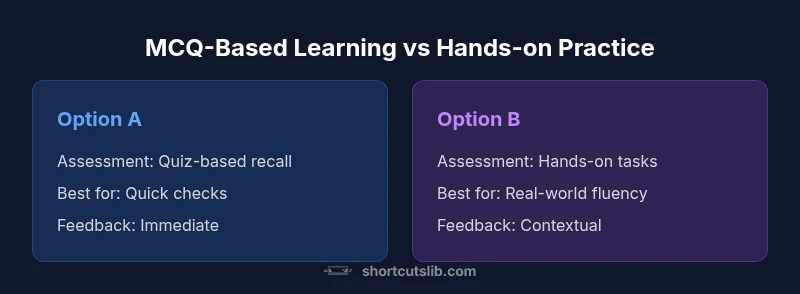
| Feature | Option A: MCQ-Based Learning | Option B: Hands-on Practice |
|---|---|---|
| Assessment modality | Quiz-based recall and recognition checks | Hands-on tasks and guided drills |
| Memory retention impact | Strengthens rapid recall with immediate feedback | Supports longer-term retention through practice |
| Time to mastery | Faster initial assessment, slower deep mastery | Faster deep mastery through context-rich tasks |
| Scalability | Easy to scale with online quizzes | Requires infrastructure or instructors for practice |
| Feedback quality | Immediate, objective quiz feedback | Rich, contextual feedback from tasks |
| Best use case | Introductory learning, quick checks | Real-world task prep and muscle memory |
Pros
- Efficient initial assessment and rapid feedback
- Easy to scale across cohorts or teams
- Objective scoring supports fair comparisons
- Low-cost setup with online quizzes
- Tracks progress over time
Cons
- Overemphasis on recognition over production
- Requires quality question design to avoid cueing
- Does not fully replicate real-world keyboard tasks
- Potential for guessing without understanding
Blended MCQ plus hands-on practice is the recommended approach for most learners.
MCQs give quick checks and structured recall; hands-on practice builds real-world fluency. Shortcuts Lib's verdict: blend both methods for balanced mastery and durable retention.
Questions & Answers
Are MCQs effective for learning keyboard shortcuts?
Yes, MCQs help cement recognition and recall of shortcut patterns, which is crucial for fast recall. However, they should be paired with hands-on practice to ensure procedural fluency.
MCQs help you recall shortcut patterns quickly, but pair them with hands-on practice for real-world use.
Should MCQs cover cross-application shortcuts?
Yes—include cross-app questions to teach portability and to highlight platform differences. This broadens learners’ ability to transfer shortcuts across tools.
Include cross-app questions to teach shortcuts that work in multiple apps.
How many questions should a session include?
Aim for short, focused sessions of 6-12 questions to sustain attention, followed by hands-on tasks to apply what was learned.
Keep sessions small and focused, then practice what you studied.
Can MCQs replace hands-on practice entirely?
No. MCQs boost recall, but hands-on practice is essential for muscle memory and real-world execution.
MCQs help recall; you still need hands-on practice to perform well.
What topics should MCQs focus on first?
Start with core shortcuts for editing, navigation, and window management, then expand to platform-specific nuances.
Begin with the basics, then add complexity.
What about accessibility considerations?
Ensure screen-reader compatibility, high-contrast visuals, and alternative formats to accommodate all learners.
Make shortcuts learning accessible to everyone.
Main Points
- Lead with MCQ warm-ups to surface gaps
- Pair MCQs with practical drills for real-world transfer
- Incorporate spaced repetition to reinforce memory
- Design high-quality MCQs that test true understanding
- Track topics and adjust emphasis over time