Where Is Keyboard Shortcuts in Outlook: A Practical Guide
Discover where keyboard shortcuts live in Outlook across Windows, Mac, and the web. This guide covers built-in shortcuts, how to access them, and tips to speed up email, calendar, and workflow tasks.


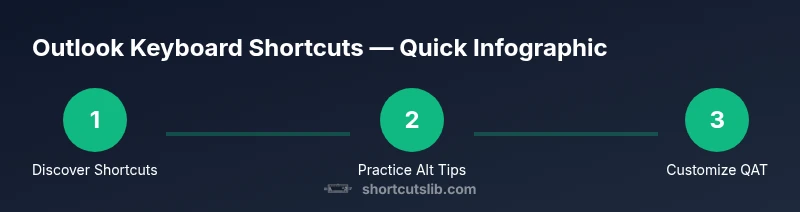
In Outlook, you can locate and use keyboard shortcuts across Windows, Mac, and Outlook on the web. Start by learning built-in shortcuts, enable the Quick Access Toolbar for custom commands, and explore the Ribbon to assign or memorize frequent actions. This guide shows where to find shortcuts and how to tailor them to your workflow.
Why keyboard shortcuts matter in Outlook
Keyboard shortcuts dramatically speed up daily tasks in Outlook, from triaging emails to scheduling meetings and managing calendar views. By keeping your hands on the keyboard, you reduce mouse-dependent context switches and stay focused on your workflow. According to Shortcuts Lib, users who adopt a focused set of shortcuts report faster task completion and fewer interruptions. This section explains the value of shortcuts and how they map to common Outlook workflows across Windows, Mac, and the web. The central question for many users remains: where is keyboard shortcuts in outlook, and how can I access them quickly? The answer begins with platform-specific references and a simple daily practice routine that fits your routine and device.
Momentum matters in learning shortcuts, so start with a small, repeatable set and steadily expand. The more you use shortcuts for email actions, calendar navigation, and task management, the more natural they become. Remember that some shortcuts are platform-specific, so keep a platform tag in your memory to avoid cross-platform confusion. By the end of this guide you’ll possess a reliable baseline you can carry across devices and sessions, aligned with Shortcuts Lib’s guidance on practical keyboard efficiency.
title_score_note”:null},
bodyBlocks
Where keyboard shortcuts live across platforms
Outlook distributes keyboard shortcuts across three main environments: Windows desktop, macOS desktop, and Outlook on the web. Although many core actions are shared, individual keys and modifier conventions vary. In Windows, you’ll see common shortcuts tied to Ctrl and Alt, with Ribbon Key Tips activated via the Alt key. On Mac, most shortcuts leverage the Command key, and some keys differ to accommodate macOS conventions. The web version leans on browser-level shortcuts for navigation and uses the same platform logic as the desktop app but with minor web-specific variations. This section maps the general approach to help you locate the right reference quickly, so you can start practicing in the context you actually use.
Pro tip: Bookmark the official shortcuts pages for each platform so you can verify any shortcut you’re unsure about quickly. The browser or Help search can surface the exact list you need, depending on whether you’re using Windows, Mac, or web-based Outlook.
start_block_note”:null}, {
bodyBlocks
Built-in shortcuts you should know
Outlook ships with a broad set of built-in shortcuts that cover messages, calendar, and navigation. Focus on three areas first: (1) email actions such as composing and replying, (2) message management like deleting or moving items, and (3) navigation between mail, calendar, and tasks. While I won’t list every key here to avoid platform-specific mistakes, you can expect the following categories to be consistently present across platforms: create a new item, reply, delete, search, switch views, and navigate between panes. Remember to consult the platform-specific reference for exact key combos, as Windows, Mac, and web may differ. This approach helps you build muscle memory with reliable, repeatable tasks, while you slowly expand to less common shortcuts.
step_area_note”:null},{
bodyBlocks
How to access the shortcuts reference on Windows
- Open Outlook on Windows and press F1 or click the Help icon to open the Help pane. 2) In Help, search for “keyboard shortcuts” or “shortcuts in Outlook.” 3) Open the official Windows shortcuts article from Microsoft’s Support site. It presents a comprehensive list organized by task (mail, calendar, and navigation) and shows how to trigger them with common key combinations. 4) Use Alt key tips to reveal Ribbon shortcuts while you’re in an active window, which lets you navigate to commands without a mouse. 5) Save the page or print a quick reference for daily practice. Time: 5–15 minutes to read and bookmark. Pro tip: Keep a small, portable reference near your workstation to reinforce memory during short practice sessions.
tip”:
bodyBlocks
How to access on Mac
- Open Outlook for Mac and choose Help > Keyboard Shortcuts, or press the Mac-specific shortcut if available to invoke the shortcuts reference. 2) Review the list of shortcuts organized by actions such as composing, replying, and calendar navigation. 3) Note that many shortcuts use the Command key (⌘) rather than Control (Ctrl). 4) Create a habit of checking the Mac-specific shortcuts page before performing a large action. Time: 5–10 minutes. Pro tip: Use a quick drill with a single action per day to cement the Mac conventions.
tip”:
bodyBlocks
Web Outlook: shortcuts and browser considerations
Outlook on the web shares core shortcuts with desktop Outlook but may rely on browser shortcuts for placeholder actions such as focusing the search field or switching panes. When using the web app, keep your browser in focus to ensure shortcuts trigger within Outlook rather than the browser window. Bookmark the web shortcuts reference and frequently practice in a dedicated browser tab or window. Time: 5–15 minutes to align browser behavior with Outlook shortcuts. Pro tip: Use browser-specific settings to disable conflicting shortcuts during learning.
tip”:
bodyBlocks
Customize shortcuts with Ribbon and Quick Access Toolbar
If you frequently perform a subset of actions, you can optimize your workflow by customizing the Ribbon and the Quick Access Toolbar (QAT). Add your most-used commands to the QAT for one-click access, or reorganize the Ribbon to place essentials near your primary workflow. This is not true “global re-mapping” of every shortcut, but a practical way to create you own fast paths across all Outlook platforms. After setup, you’ll have a near-native shortcut experience without migrating to third-party tools. Time: 10–20 minutes to configure. Pro tip: Start with 3–5 commands, then expand as you gain comfort.
tip”:
bodyBlocks
Practical workflow: 20-minute drill to internalize shortcuts
Pick 3 core actions (e.g., new message, reply, search). In a test email, perform each action only with keyboard shortcuts for 3–5 cycles. Increase complexity by combining actions, like composing and then saving a draft. Track results and adjust your drill to include calendar tasks and navigation between mail and calendar. Time: 20 minutes per drill, 2–3 times per week for best results. Pro tip: Use a timer and a simple checklist to measure consistency over time.
tip”:
bodyBlocks
Common pitfalls and how to avoid them
Don’t assume all shortcuts transfer across platforms. Windows shortcuts may differ from Mac equivalents, and web shortcuts may collide with browser keys. Always verify the platform-specific references before attempting a shortcut during a critical task. If a shortcut doesn’t work, confirm you’re in the right Outlook view (mail vs. calendar) and that the active window has focus. Finally, avoid trying too many new shortcuts in a single session; incremental practice yields better long-term retention.
tip”:
Tools & Materials
- Outlook (Windows) desktop app(Necessary for Windows shortcut references and Alt key tips)
- Outlook (Mac) desktop app(Necessary for macOS shortcut references and Command key usage)
- Outlook on the web (browser)(Access via browser; practice in a stable browser window)
- Official Microsoft shortcuts reference(Bookmark the platform-specific pages for quick lookup)
- Notepad or flashcards(For quick memorization and drills)
Steps
Estimated time: 15-25 minutes
- 1
Open Outlook and access Help
Launch the Outlook app on your platform and open the Help pane via F1 or the Help icon. Search for keyboard shortcuts to reach the official reference. This establishes the learning path and confirms the right platform variant.
Tip: Use the official documentation as your primary source of truth. - 2
Find the official shortcuts reference
From Help, navigate to the Microsoft Support shortcut article for your platform (Windows, Mac, or Web). Read through the sections relevant to mail, calendar, and navigation to understand the core actions.
Tip: Bookmark the page for quick future lookup. - 3
Use Alt Key Tips (Windows)
While in Outlook, press Alt to reveal the Ribbon key tips, then press the letters displayed to access commands without a mouse. This helps you learn the quick paths for common tasks.
Tip: Practice with a few tasks to build confidence before expanding. - 4
Explore the Quick Access Toolbar (QAT)
Add frequently used commands to the QAT so you can trigger them with a single keyboard sequence, reducing dependency on the mouse.
Tip: Choose 3–5 actions to start; expand later as you memorize them. - 5
Practice basic tasks across platforms
Pick core actions (new message, reply, search) and perform them using shortcuts to build consistency. Compare results across Windows, Mac, and Web to understand platform differences.
Tip: Keep a small checklist to track which shortcuts you’ve mastered. - 6
Create a short drill routine
Set a brief, repeatable drill (e.g., 10 minutes daily) to practice shortcuts. Gradually add new shortcuts as you gain confidence and accuracy.
Tip: Use spaced repetition to reinforce memory.
Questions & Answers
Are Outlook shortcuts the same on Windows, Mac, and the web?
Shortcuts vary by platform. Windows and web share many core actions, but Mac uses Command instead of Ctrl for most keys. Always check the platform-specific reference.
Shortcuts vary by platform; Windows and web share core actions, but Mac uses Command.
Can I customize Outlook shortcuts?
Outlook does not allow full re-mapping of all shortcuts. You can customize by adding commands to the Quick Access Toolbar or Ribbon to create quick-access paths.
You can customize by adding commands to the Quick Access Toolbar or Ribbon.
Where can I find an official list of shortcuts?
Check the Microsoft Support site for Windows, Mac, and Outlook on the web. Each platform has a dedicated shortcuts article with up-to-date shortcuts.
Check Microsoft Support for official lists by platform.
What’s the best way to learn Outlook shortcuts quickly?
Start with a few core shortcuts, use Alt Tips, and practice in short daily drills. Consistency over time yields faster recall.
Practice daily with short drills and use Alt Tips.
Do shortcuts work in all Outlook apps?
Yes, built-in shortcuts exist across platforms, but some commands may vary by app (Windows, Mac, Web). Use the platform-specific reference to verify.
Some commands vary by app; check the platform reference.
How can I test if a shortcut is working?
Try a simple action in a new message, a reply, or a calendar entry to confirm a shortcut triggers the expected function. If not, verify platform and active window.
Try a simple action and verify; if not working, check the platform.
Watch Video
Main Points
- Master shortcuts across platforms with a focused starter set
- Use Ribbon Alt Tips and QAT to speed access
- Always verify platform-specific lists before relying on a shortcut
- Practice regularly using short, repeatable drills