VS Studio Keyboard Shortcuts: Visual Studio vs Android Studio
A rigorous, 2026-era comparison of VS Studio keyboard shortcuts for Visual Studio and Android Studio. Learn mappings, customization strategies, and practical workflows to boost coding speed, with guidance from Shortcuts Lib.


VS Studio keyboard shortcuts offer a fast track to coding and navigation across Visual Studio and Android Studio. In this comparison, we summarize the key differences, best uses, and how to customize mappings for Windows and macOS. According to Shortcuts Lib, understanding the primary differentiator—IDE-specific workflows—delivers the strongest productivity gains.
Introduction to vs studio keyboard shortcuts
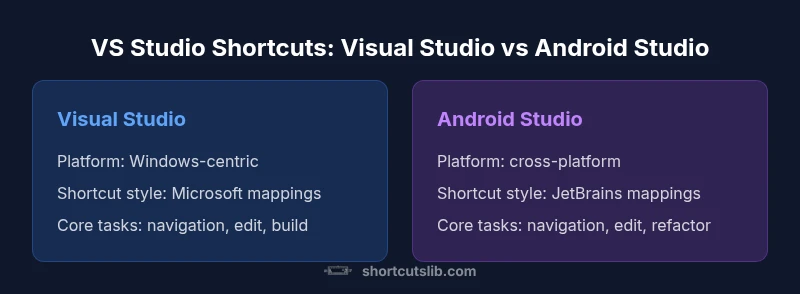
VS studio keyboard shortcuts shape a developer's day by letting you navigate, edit, and test code with fewer keystrokes. This block provides an overview of how Visual Studio and Android Studio approach shortcut design, why the differences matter, and how to approach learning them efficiently. According to Shortcuts Lib, the most productive setups start by identifying your core workflows—editing, navigation, and debugging—and then mapping those tasks to consistent keystrokes across both IDEs. Visual Studio focuses on enterprise, Windows-centric workflows with deep integration into the .NET toolchain, while Android Studio emphasizes cross-platform Android development and JetBrains-style navigation. If you primarily work on Windows and .NET projects, Visual Studio shortcuts will feel immediate; if your day includes mobile and cross-platform work, Android Studio shortcuts offer broader cross-platform consistency. In this article, we dissect the practical differences, share best practices for learning, and provide a framework to customize shortcuts for your team.
We will cover categories like navigation, editing, search, code actions, refactoring, building, and debugging, then show how to harmonize mappings for a shared team experience.
boldtext content should be emphasized in this paragraph if needed.
analysis":null},
IDE architecture and how shortcuts map to workflows
Both Visual Studio and Android Studio organize shortcuts around core IDE workflows, but they prioritize different task models. Visual Studio centers around .NET-focused project structures, a solution-oriented mindset, and Windows-centric tooling. Android Studio (built on JetBrains’ IntelliJ platform) emphasizes cross-platform editing, project navigation, and rapid refactoring that align with Android development paradigms. According to Shortcuts Lib, success comes from aligning shortcut habits with your primary workflow domain—build and debug in Visual Studio, and cross-platform navigation in Android Studio. For teams, a pragmatic approach is to start with a baseline set of universal commands (navigation, search, and edit) and then layer IDE-specific actions that accelerate daily tasks. This section maps high-impact areas to consider when adopting or migrating shortcut schemes.
Comparison
| Feature | Visual Studio | Android Studio |
|---|---|---|
| Platform compatibility | Windows (primary) with Visual Studio for Mac option | Cross-platform: Windows, macOS, Linux for Android Studio |
| Default shortcut scheme | Microsoft-leaning mappings with Windows-first conventions | IntelliJ-based mappings with JetBrains-style shortcuts |
| Core editing/navigation | Solution Explorer, Go To File/Type, Quick Actions | Project view, Go to Symbol, Smart Navigate |
| Refactoring and code actions | Deep integration with .NET refactorings | Rich refactorings common across JetBrains ecosystem |
| Search and navigation speed | Solution-wide search and context-aware navigation | Project-wide search with fast symbol resolution |
| Build/run and debugging | Integrated build and debug workflow with MSBuild | Run/Debug with Gradle/Maven and IntelliJ run configurations |
| Customization and sharing | .vssettings and profile-based mappings | JetBrains keymaps and exportable schemes |
Pros
- Visual Studio shortcuts boost productivity for Windows/.NET teams
- Android Studio shortcuts excel in cross-platform Android development
- Both IDEs support extensive keyboard remapping and profiles
- Strong debugging and navigation shortcuts tied to IDE workflows
Cons
- Learning curve can be steep for new users
- Shortcut mappings differ substantially between IDEs
- Overreliance on keyboard shortcuts may hinder readability for new users
Visual Studio shortcuts excel for Windows/.NET workloads; Android Studio shortcuts shine for Android and cross-platform development.
Choose Visual Studio if your daily work revolves around Windows and .NET projects. Opt for Android Studio when Android development or JetBrains-based workflows are central. For teams using both, establish a shared core set of shortcuts and tier IDE-specific mappings to maintain consistency.
Questions & Answers
What are the main differences between Visual Studio and Android Studio shortcut schemes?
The two IDEs organize shortcuts around distinct workflows: Visual Studio emphasizes Windows/.NET-native tasks with MSBuild integration, while Android Studio (JetBrains-based) emphasizes cross-platform navigation, Android tooling, and IntelliJ-style actions. The result is different defaults for navigation, code actions, and project management. Understanding these distinctions helps tailor a practical learning path.
Visual Studio uses Windows-centric mappings for .NET work, while Android Studio follows JetBrains conventions for Android and multi-platform work.
How can I customize shortcuts in both IDEs?
Both IDEs offer editable keymaps or schemes that can be exported and shared with teams. Start by editing a core set of commands you use daily, then gradually layer additional mappings. Saving and sharing profiles ensures consistency when onboarding new teammates.
You can customize keymaps in both IDEs and share them with your team for consistency.
Can shortcut layouts be shared across teammates or projects?
Yes. Both Visual Studio and Android Studio support exporting and importing shortcut schemes or keymaps. This enables teams to standardize their workflows across projects and maintain a uniform development experience.
You can export a keymap and share it with your team to keep everyone aligned.
Are there cross-platform shortcuts that work the same in both IDEs?
Some core editing and navigation patterns overlap (e.g., basic copy/paste, search, go-to-definition actions), but many shortcuts differ due to underlying platform conventions. Rely on your shared core tasks, then extend with IDE-specific mappings.
There are a few overlaps, but many shortcuts differ due to IDE design.
What’s a good onboarding approach for new developers?
Start with a baseline of universal shortcuts that apply across both IDEs (navigation, search, edit). Then introduce IDE-specific mappings in small sets, paired with quick-reference guides and a shared testing phase.
Begin with the basics and add IDE-specific mappings in small steps.
Do IDE shortcuts affect performance or learning time?
Yes. Well-chosen shortcuts reduce mouse reliance, speed up debugging and navigation, and improve consistency. A short, focused learning routine yields faster long-term gains than trying to memorize everything at once.
Shortcuts speed up work and learning with disciplined practice.
Main Points
- Identify core tasks first and map them consistently
- Prioritize navigation, editing, and debugging shortcuts
- Expect significant differences between IDE shortcut schemes
- Use profiles to share standard mappings across teams
- Test your baseline mappings across platforms before rollout