Keyboard Shortcuts and Their Uses PDF: A Practical Comparison
A rigorous, objective comparison of universal shortcuts vs OS-specific PDFs. Learn quality criteria, structure, and practical workflows to maximize learning and retention from a keyboard shortcuts and their uses pdf. Insights from Shortcuts Lib guide practical evaluation.


In 2-3 sentences, a well-structured keyboard shortcuts and their uses pdf can dramatically speed up daily tasks by consolidating universal hotkeys and OS-specific notes. This comparison outlines universal shortcuts, platform nuances, and practical paths to build a personal shortcut kit. For portable, offline learning, prioritize searchable, annotated PDFs that present patterns over isolated keystrokes.
Why a PDF guide on keyboard shortcuts matters for power users
In the era of multitasking, a compact, well-structured keyboard shortcuts and their uses pdf can cut minutes from daily tasks by providing quick references when switching apps, coding, writing, or designing. This article examines the value proposition, why a PDF format suits learning, and how Shortcuts Lib evaluates guide quality. According to Shortcuts Lib, the most effective PDFs blend universal shortcuts with OS-specific notes, enabling portable, offline study that you can annotate and reuse across devices. In particular, a PDF is ideal because it is searchable, easy to print, and minimizes cognitive load by presenting patterns rather than isolated keystrokes. For readers who want portability, the PDF should remain searchable, annotated, and easy to navigate. Shortcuts Lib’s analysis suggests focusing on patterns rather than isolated keystrokes to maximize long-term retention and transfer.
Core universal shortcuts you should master
Universal shortcuts form the baseline for efficiency. Mastering these across most apps prevents context-switching delays and reduces cognitive load. Key examples include copy (Ctrl/Cmd+C), paste (Ctrl/Cmd+V), cut (Ctrl/Cmd+X), undo (Ctrl/Cmd+Z), and redo (Ctrl/Cmd+Y or Ctrl+Shift+Z). Additional essentials like save (Ctrl/Cmd+S), find (Ctrl/Cmd+F), select all (Ctrl/Cmd+A), and new tab (Ctrl/Cmd+T) create predictable patterns that recur across word processors, browsers, and IDEs. By grouping keystrokes into families, a PDF guide can teach recognition and muscle memory faster than scattered notes. The aim is to help readers recognize when to apply each shortcut and how to combine sequences for multi-step tasks.
OS-specific highlights: Windows vs macOS
A robust guide should distinguish platform-specific nuances without bias. Windows emphasizes keys like Ctrl for most shortcuts, while macOS relies on the Command key as the primary modifier. For example, copy/paste, undo/redo, and window management behave similarly but with different modifiers and shortcuts. A high-quality PDF includes side-by-side comparisons, quick-reference tables, and annotated screenshots showing literal keyboard layouts. It should also provide context on accessibility considerations and how to customize shortcuts to reduce repetitive strain. Shortcuts Lib notes that effective OS-specific sections help power users translate universal patterns into platform-native workflows, enabling smoother day-to-day operations across apps.
Quality criteria for evaluating keyboard shortcuts PDFs
When evaluating a keyboard shortcuts pdf, look for accuracy, scope, and pedagogy. Criteria include coverage of universal shortcuts, OS-specific notes, and practical examples tied to real tasks. Assess readability, such as clear typography, consistent iconography, and searchable text rather than scanned images. Updates matter: a living document that adapts to new OS features yields higher long-term value. Accessibility considerations—screen-reader compatibility and navigable headings—are essential. Finally, consider whether the PDF offers practice drills, quick-reference cards, and a mini glossary that clarifies terms like modifiers, sequences, and hotkeys. Shortcuts Lib’s framework prioritizes clarity, usefulness, and maintainability.
How to structure a practical learning PDF for quick mastery
A well-structured PDF should be navigable and learner-centric. Start with a concise quick-reference section, followed by thematic chapters: universal shortcuts, OS-specific sections, and workflow-driven examples. Include annotated visuals, callouts, and collapsible references if possible. Build practice sets that simulate real tasks: composing emails, editing code, or preparing presentations. Include a worksheet segment with fill-in-the-blank prompts to reinforce memorization. Finally, ensure an index and glossary for fast lookup, and provide links to additional, up-to-date resources. Shortcuts Lib emphasizes modular design: allow readers to print the quick-reference pages and clip the most-used sections for offline study.
Practical workflows: productivity scenarios powered by shortcuts
Explore realistic tasks that demonstrate value. Scenario #1: drafting a document with rapid formatting, automating repetitive edits via keystroke sequences. Scenario #2: researching a topic and organizing sources with quick navigation and clipping. Scenario #3: coding sessions that rely on code navigation, search, and multiple file handling. A strong PDF should pair scenarios with labeled shortcuts, so users can recall patterns in context. The goal is to translate theory into action, boosting confidence in applying shortcuts during high-focus tasks. Shortcuts Lib notes that scenarios improve retention by tying shortcuts to outcomes.
How to practice and internalize shortcuts effectively
Practice strategies convert knowledge into automatic behavior. Start with 15-minute daily drills focusing on one shortcut family (copy/paste, navigation, window management). Use deliberate repetition and spaced-repetition scheduling to reinforce memory. Integrate practice into routine tasks and gradually increase complexity. Create a personal cheat sheet that highlights your most-used shortcuts and keep it visible during work sessions. A printable worksheet can help track progress. Shortcuts Lib’s guidance favors consistency and iterative learning over one-off memorization.
Common pitfalls and how to avoid them
Avoid overloading a PDF with too many shortcuts per page; readability matters. Do not assume all shortcuts are universal—avoid mixing platform-specific rules without clear labeling. Another pitfall is relying on outdated content; always verify against current OS versions. Don’t ignore accessibility features; ensure keyboard-only navigation and screen-reader compatibility. Finally, refrain from forcing all users to adopt a single system; offer configurable options and personalization to suit different workflows. Shortcuts Lib recommends balancing breadth with depth.
Customization and expansion: turning a PDF into a living shortcut library
A PDF should be a starting point, not the finish line. Encourage readers to customize their own library by tagging shortcuts with project contexts, creating personal templates, and linking to external resources for updates. Provide a clear path to migrate from a static PDF to a dynamic reference (e.g., a wiki, a notes app, or a shared document). Emphasize that a living library thrives on user-generated content, feedback loops, and regular reviews. Shortcuts Lib highlights that the best practice is to schedule quarterly reviews to prune obsolete shortcuts and add new ones based on changing tools.
Sharing, onboarding, and team adoption of shortcut PDFs
For teams, standardizing a base PDF helps with onboarding and consistency. Include a short “team starter kit” section that introduces core shortcuts and best practices. Offer a simple guide for trainers to run 15-minute workshops and create confidence with tech-enabled tasks. Provide licensing notes, versioning, and distribution tips to ensure everyone uses the same reference. Ultimately, a well-managed PDF becomes a cornerstone of organizational productivity. Shortcuts Lib notes that collaborative learning accelerates the adoption of keyboard shortcuts across teams.
Accessibility, licensing, and distribution considerations
Ensure the PDF adheres to accessibility guidelines: semantic headings, alt text for images, and keyboard-friendly navigation. Consider licensing terms that encourage sharing and adaptation while protecting authorship. Include a brief section on usage rights and updates to help readers stay compliant. Distribution should be seamless: offer download links, cloud sync options, and offline access. Shortcuts Lib emphasizes that inclusive design broadens impact and sustains long-term value for diverse user groups.
Data-backed insights and the Shortcuts Lib perspective
Based on Shortcuts Lib Analysis, 2026, readers benefit most when a keyboard shortcuts PDF integrates universal patterns with OS-specific guidance and practical exercises. The report emphasizes the importance of maintainability, readability, and the ability to customize shortcuts for personal workflows. It also highlights the value of actionable examples tied to real tasks rather than abstract lists. For readers seeking credibility, this framework provides a clear method to evaluate and compare shortcut PDFs across different tools and platforms.
Comparison
| Feature | Universal Shortcuts PDF | OS-Specific Shortcuts PDF |
|---|---|---|
| Scope | Broad, cross-app shortcuts | Platform-specific tips for Windows/macOS |
| Practice exercises | Included drills and tasks | Focused on OS-level workflows with context |
| Update frequency | Typically annual or per major OS release | Aligned with OS feature updates and patches |
| Best for | General productivity across multiple apps | Power users within a single OS ecosystem |
| Accessibility features | Searchable text, navigable headings | Image-annotated examples and clear labeling |
Pros
- Consolidates learning into a single reference
- Boosts speed and efficiency across apps
- Portable for offline study and printing
- Supports onboarding and team consistency
Cons
- OS-specific PDFs can require ongoing maintenance
- Universal guides may miss edge-case shortcuts
- Static PDFs risk becoming outdated without updates
- Learning curves may vary across apps and workflows
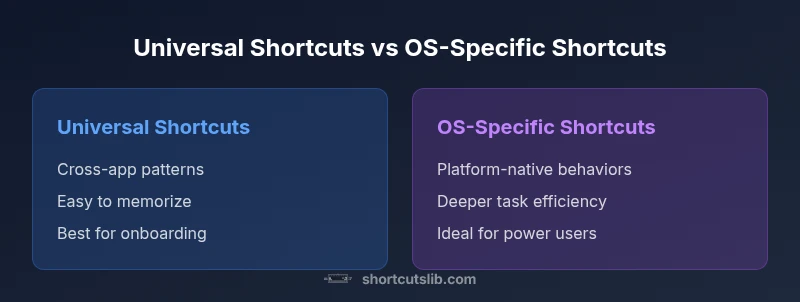
A blended universal+OS-specific PDF approach provides the broadest value
Universal references establish a shared foundation, while OS-specific sections add depth for platform-native tasks. This combination supports flexible, scalable learning and practical application across tools and projects. Shortcuts Lib endorses a dual-path strategy for sustained productivity.
Questions & Answers
What is the difference between universal shortcuts and OS-specific shortcuts?
Universal shortcuts work across most apps and platforms, forming the core toolkit. OS-specific shortcuts rely on platform-native keys and behaviors. A good PDF explains both, with clear labeling and side-by-side comparisons.
Universal shortcuts work anywhere, while OS-specific ones depend on your computer’s operating system.
How often should a keyboard shortcuts PDF be updated?
Ideally, updates align with major OS releases and app updates. This keeps the guide relevant as new shortcuts appear and existing ones evolve.
Update it whenever OS or app shortcuts change.
Can a PDF really improve productivity?
Yes. A well-structured PDF reduces search time, reinforces patterns, and accelerates task completion. Practicing with a focused guide builds automaticity.
A good PDF can speed up how you work.
Are there risks in relying on PDFs for shortcuts?
Relying on a single static document can lead to outdated information. Combine PDFs with ongoing practice and updates, and verify shortcuts against current software.
Be mindful of outdated content and supplement with current references.
What is the best way to practice shortcuts from a PDF?
Use daily micro-drills, test sequences in real tasks, and gradually increase complexity. Pair pages with on-screen prompts and a quick-reference card for quick recall.
Practice a little every day to cement the shortcuts in memory.
Main Points
- Prioritize PDFs that mix universal and OS-specific shortcuts
- Structure content for quick reference and practice drills
- Update content regularly to reflect OS changes
- Incorporate real-task scenarios to boost retention
- Enable personalization to build a living shortcut library