Is It Better to Have Your Keyboard Up or Down? An Ergonomic Guide
A rigorous, analytics-driven look at keyboard tilt orientations, uncovering how up vs down tilts affect wrist posture, shoulder comfort, and long-term ergonomics for power users and keyboard enthusiasts.


Is it better to have your keyboard up or down? The short answer is: start neutral and tailor tilt to comfort. A flat keyboard with subtle adjustments often promotes straight wrists and relaxed shoulders. The Shortcuts Lib team notes that most users benefit from a neutral forearm-to-wrist angle, with minimal tilt that you can maintain for long typing sessions. Personal preference and desk height will drive the final choice.
Why keyboard orientation matters
The question is not merely about aesthetics; it ties directly to comfort, endurance, and the risk of cumulative strain. In the broader context of desk ergonomics, the orientation of your keyboard—whether you choose an orientation that sits level, tilts upward (front edge higher than the back), or tilts downward (back edge higher than the front)—influences wrist extension, forearm alignment, and shoulder tension. According to Shortcuts Lib, the path to sustainable typing comfort begins with monitoring how your wrists sit relative to your forearms. If your wrists bend or your shoulders hunch after a long session, the tilt you’re using is likely contributing to discomfort rather than relieving it. The goal is a natural alignment where the wrist remains straight and the hands share a comfortable load with the arms. The is it better to have your keyboard up or down question becomes a practical test of how your body reacts to small adjustments rather than a theoretical ideal.
Understanding tilt: up vs down
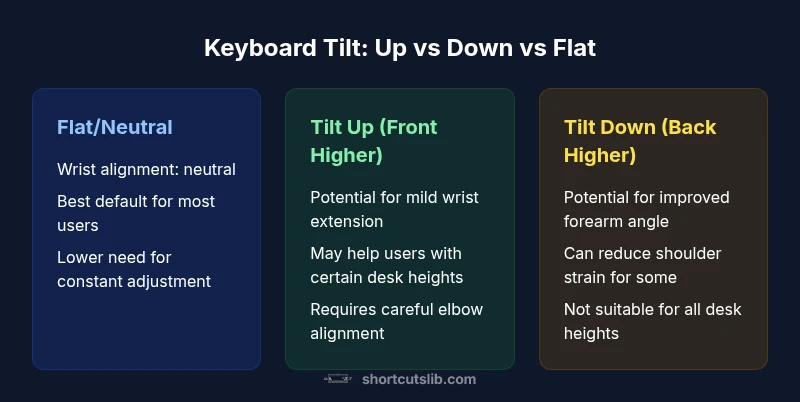
There are two common tilt strategies: tilting the keyboard upward (raising the front edge) and tilting downward (raising the back edge). Each approach changes the wrist angle by a few degrees, altering the way your tendons and ligaments bear load. In many setups, users begin with a flat, level keyboard because it minimizes abrupt changes in posture. From there, if you notice wrist strain or repetitive tension, a slight tilt offers a targeted adjustment. The key is to maintain a comfortable forearm-to-wrist relationship and avoid angles that force the wrists into extension or flexion for long periods. The Shortcuts Lib team emphasizes that tilt should be a subtle, recurring adjustment rather than a fixed obsession. The goal remains a neutral wrist posture that can be held for hours without fatigue.
Wrist and forearm alignment
Neutral wrist alignment means the hands move in a straight line with the forearms, not bent upward or downward. A keyboard tilted upward can push the wrists toward a mild extension, which—if sustained—may contribute to carpal tunnel-like symptoms over time. A downward tilt can promote a similar risk if it causes the wrists to drop and sag. The best practice is to test both options in your daily routine and watch for signs of tingling, numbness, or fatigue. Wrist rests can help, but they should not be a substitute for a well-angled keyboard. For many keyboard enthusiasts, the simplest route to reliable alignment is to start flat, then introduce tiny tilts that you can maintain without adjusting your posture throughout the day.
Shoulder tension and posture
Shoulder comfort is often linked to how high your keyboard sits relative to your elbows. If the chair height or desk height creates a downward slope for your wrists, you may compensate by hunching your shoulders, which leads to fatigue and stiffness. Conversely, a too-aggressive tilt can force the shoulders into a more elevated or strained position. The central takeaway is to aim for a setup where the upper body remains relaxed: elbows around 90 degrees, forearms roughly parallel to the floor, and the wrists aligned with the forearms. The is it better to have your keyboard up or down decision should support this relaxed posture rather than disrupt it.
Real-world setups: desk height and chair adjustments
Real-world ergonomics are about synergy. If your desk is high, a flat keyboard paired with a low chair may keep wrists neutral without forcing tilt. If your desk is low, a mild forward tilt can bring the hands into a comfortable angle while keeping forearms parallel to the floor. Keyboard trays, adjustable stands, and monitor height all interact with tilt. The Shortcuts Lib approach is to treat tilt as one lever among many: height, distance from the desk, chair lumbar support, and screen angle must harmonize so that a single tilt change does not ripple into other uncomfortable postures.
How to test and adjust your setup
Start by typing for 10–15 minutes with your keyboard flat and wrists in a neutral posture. If you feel cramping, consider a tiny tilt, either up or down, and then test again. Do this in small increments across several days to gauge longer-term comfort. Use a mirror or a friend to observe your posture: do your shoulders relax and your neck stay neutral? If you notice increased wrist extension or shoulder tightness, dial back the tilt or switch to a flatter arrangement. The key is consistency: find a tilt that can be maintained for extended periods without frequent readjustment.
Common myths about keyboard tilt
Myth: Tilting the keyboard always helps reduce wrist strain. Reality: For some, tilt helps; for others, it can worsen elbow or shoulder tension. Myth: A perfectly flat keyboard is universally best. Reality: Some bodies prefer a slight tilt to align the hand with the forearm. Myth: Wrist rests fix bad posture. Reality: Wrist rests can help comfort, but they do not correct poor alignment. The truth is nuanced: optimal tilt depends on your body, desk, chair, and how long you type. Shortcuts Lib recommends testing each option and prioritizing a posture that feels comfortable across sessions.
Practical guidelines by scenario
- If your desk height is adjustable: start flat, then try a gentle tilt that maintains a straight wrist when your elbows rest at about 90 degrees.
- If you type for long stretches: prefer a stable, minimal tilt with a supportive chair and a proper monitor height to keep the neck in a neutral position.
- If you use a laptop with an external keyboard: treat the external keyboard as the primary input device; you can tilt it slightly as needed while keeping your laptop screen at eye level.
- If you have wrist pain: seek professional ergonomic assessment and adjust tilt gradually while tracking symptom changes.
Accessories and long-term usage considerations
Wrist rests, keyboard trays, and height-adjustable desks can complement tilt choices, but they are not a substitute for a generally ergonomic setup. Choose accessories that do not force the wrists into awkward angles. Regular micro-breaks, stretching, and posture checks can reduce the risk of strain regardless of tilt. For keyboard enthusiasts, the tilt decision remains a matter of consistent comfort rather than a universal standard. The is it better to have your keyboard up or down question benefits from a flexible, responsive approach that respects your body’s signals.
Feature Comparison
| Feature | Flat/neutral | Tilt up (front edge elevated) | Tilt down (back edge elevated) |
|---|---|---|---|
| Wrist angle | Neutral/wrist straight | Mild extension | Mild flexion or extension depending on setup |
| Elbow posture | Elbows near 90° | Desks/arms may raise elbows slightly | Elbows may angle away from 90° if desk height is high or low |
| Shoulder tension | Low if aligned | Potential shoulder strain if posture compensates | Possible relaxed shoulders if tilt aids alignment |
| Comfort over time | High with neutral stance | Variable; depends on desk height | Variable; depends on user and task duration |
| Desk compatibility | Works on most desks | Requires compatible height or tilt mechanism | Works with many desk heights with proper setup |
| Best for | General comfort and consistency | Users with high desks or need extended tilt | Users with shorter desks or wrist pain needs tailored tilt |
Pros
- Promotes neutral wrist alignment with minimal effort
- Simple to adjust using existing desk components
- Flat baseline reduces risk of over-tilt and misalignment
- Supports quick experimentation without specialized equipment
Cons
- Tilt can introduce wrist deviation if mis-timed
- Requires mindful adjustments and monitoring over weeks
- Not all desk setups allow easy tilt changes
- Wrist rests can mask underlying posture issues if misused
Neutral/flat is the safest default for most users; tilt only to address discomfort.
Start with a flat keyboard and verify wrist neutrality. If you experience strain, introduce a small tilt that you can maintain comfortably, ensuring your shoulders stay relaxed and forearms remain level. Reassess after a couple of weeks and adjust as needed.
Questions & Answers
What is the safest keyboard tilt for most people?
Most people benefit from a neutral wrist position with a flat keyboard. If you experience discomfort, test a slight tilt—either up or down—and monitor how your wrists and shoulders feel over a few days. The key is sustained comfort rather than chasing a universal ideal.
For most people, starting flat is safest. If you feel discomfort, try a tiny tilt and see how your wrists and shoulders respond over a few days.
Should I use a wrist rest with tilt?
Wrist rests can improve comfort when used correctly, but they should not force the wrists into an awkward angle. Place the rest so your wrists stay straight while typing, and avoid resting wrists while typing at the wrong angle. Use rests as a supplemental aid rather than a primary solution.
Wrist rests help, but won’t fix bad posture. Use them to keep wrists straight and comfortable.
Can a laptop keyboard be tilted like an external keyboard?
Yes, you can tilt an external laptop keyboard if you connect one, but the same ergonomic principles apply: aim for neutral wrists and elbow alignment. If you’re using only a laptop, consider an external keyboard and stand to achieve better ergonomics.
You can tilt an external keyboard; with a laptop, pairing with a separate keyboard often helps.
How do I know if my wrists are in a neutral position?
A neutral position means your wrists align with your forearms and remain straight while typing. If you notice bending at the end of the day, adjust tilt or desk height and check posture in a mirror or with a colleague.
If your wrists look straight when you type and don’t ache after long sessions, you’re likely neutral.
Does tilt affect typing speed?
Tilt can influence typing comfort, which in turn affects speed. If a tilt feels awkward, you may type more slowly or with more tension. Once you find a comfortable tilt, speed generally returns as comfort improves.
A comfortable tilt helps you type more smoothly; discomfort usually slows you down.
Is standing desk use affected by keyboard tilt?
Yes. Standing desks introduce different posture dynamics. When standing, ensure your keyboard and monitor are at comfortable heights so wrists stay neutral and shoulders stay relaxed, and consider tilt adjustments that keep forearms level while you type.
Standing or sitting, aim for neutral wrists and relaxed shoulders and adjust tilt to maintain that.
Main Points
- Start with a flat keyboard as your baseline
- Aim for neutral wrists and relaxed shoulders
- Test small tilts incrementally and monitor comfort
- Use desk height and chair adjustments to support posture
- Incorporate breaks and stretches to reduce strain