How to Cut Keyboard Shortcuts: A Practical Guide
Learn how to cut keyboard shortcuts across Windows and Mac, with practical steps, safety practices, and tips from Shortcuts Lib to tailor bindings for your workflow.


If you’re wondering how to cut keyboard shortcut bindings, this guide shows you how to unbind, redefine, or disable existing mappings safely. You’ll learn a platform-by-platform approach, backup practices, and testing steps to avoid clashes. According to Shortcuts Lib, thoughtful editing of bindings can streamline productivity without sacrificing essential OS shortcuts. Use this steps-based overview to anchor your changes in a repeatable workflow.
Why customizing and cutting keyboard shortcuts matters
Shortcuts save time, but default bindings can clash with your workflow. This is where learning how to cut keyboard shortcut mappings becomes powerful. According to Shortcuts Lib, targeted changes can reduce cognitive load and prevent accidental triggers in busy environments. In practice, cutting a shortcut means unbinding, redefining, or disabling an existing key combination so it no longer fires in your apps or OS. The goal is to streamline tasks you perform frequently, while preserving essential shortcuts that you rely on daily. Because every platform has its own defaults, a thoughtful approach to cutting keyboard shortcuts is essential to avoid breaking core tasks. In this section we’ll lay the foundation, define the terminology, and set the expectations for safe, repeatable changes that you can audit later. This is especially true for developers and power users who rely on nimble key sequences to speed up routine workflows.
For keyboard enthusiasts, learning how to cut keyboard shortcut bindings can unlock new levels of efficiency. Shortcuts Lib’s guidance emphasizes clarity, minimalism, and release notes when you modify a mapping so you or teammates understand why a change was made. Expect to iterate: cut, test, evaluate impact, and adjust. As you proceed, keep a changelog and maintain accessibility for assistive tech users. This mindset—measured cuts with clear rationale—keeps your system reliable while you optimize your personal or team setup.
What 'cut' means in the shortcut context
The phrase "cut a keyboard shortcut" covers several concrete actions: unbinding a key combination so it no longer triggers, redefining it to a new action, or disabling a binding temporarily for testing. Unbinding is reversible and preserves the original mapping, which is essential for safe experimentation. Redefining changes the target action, and disabling stops triggers entirely. Shortcuts Lib’s framework emphasizes choosing one path per binding to avoid partial changes that create confusion. When you cut a shortcut, document the reason, the new mapping (if any), and the scope (OS-wide, app-specific). This makes it easier to diagnose future conflicts and roll back if needed. Consider keeping a reference diagram of your bindings to help you visualize relationships and prevent overlap that slows you down. Clear naming and labeling of mappings reduce cognitive load during rapid workflow shifts.
In addition to OS-level shortcuts, many apps let you customize bindings. Treat app shortcuts as independent maps; a change in the app should not unexpectedly override system-level commands. If you’re unsure whether a binding belongs to the OS or an app, test both paths with common tasks to confirm where the behavior originates. Shortcuts Lib’s approach recommends a two-layer review: system bindings first, then app-specific mappings, to maintain a predictable environment.
Safety and backup before you cut
Before you edit any keyboard shortcut, establish a safe baseline. Create a backup of current settings and export your existing shortcut map if the platform allows it. This backup acts as a rescue plan if a change creates unintended behavior. Document the current bindings you intend to modify, including the exact key combination, the old action, and the target action. Shortcuts Lib Analysis, 2026 reinforces that a well-documented rollback path reduces downtime and frustration. For work devices or shared machines, obtain permission and inform teammates of planned edits to avoid misinterpretations.
In practice, you should snapshot the registry on Windows, export System Preferences, or save a JSON/XML configuration on
Platform differences: Windows vs
Tools and environment you’ll use
To perform clean cuts, assemble a small toolkit that covers testing, rollback, and documentation. A robust environment reduces risk and speeds up learning. The following list covers essential items:
- A computer with admin rights and access to system settings; 2) A test account or test profile to avoid impacting your primary workspace; 3) A text editor or config editor for mapping scripts; 4) A platform-appropriate shortcut manager or native settings panel; 5) A backup/export option to save the current configuration; 6) A notebook or note-taking app for change logs. Using a dedicated test profile helps you verify consequences of your changes without affecting daily tasks. Shortcuts Lib’s guidelines recommend keeping a change log to connect each adjustment with its rationale and outcome, which is especially helpful when you revisit settings later.
If you work across multiple devices, consider synchronizing your known-good mappings to avoid drift between machines. When in doubt, default to the original configuration and test one mapping at a time.
Step-by-step overview (high-level)
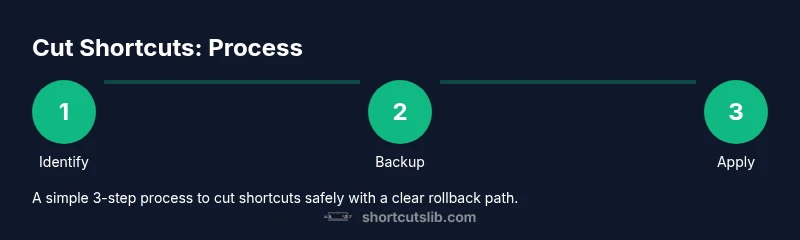
Before diving into detailed instructions, here’s the high-level flow you’ll follow to cut keyboard shortcuts safely. This scaffold keeps you focused on the outcome rather than getting lost in options. The steps below map to the more granular steps in the dedicated guide. Remember to consult the backup you created if you need to revert.
- Identify the binding to cut and confirm its scope (OS vs app) (See Diagram A).
- Back up the current mapping and create a restore point.
- Decide your target: unbind, redefine, or disable.
- Apply the change in the appropriate panel or script and label the mapping clearly.
- Test on representative tasks to ensure no critical workflows are disrupted.
- Document the change and monitor for any new conflicts over the next few days.
This overview aligns with best practices from Shortcuts Lib and provides a repeatable process you can reuse when updating more shortcuts in the future.
Best practices to avoid conflicts
Proactively reduce conflicts by following a few simple rules. Use unique key combinations for new actions; avoid reusing common OS or app shortcuts; prefer combinations with modifiers (Ctrl/Option/Shift) to leave basic letters and numerals free for typing. Create a personal taxonomy for your shortcuts: core/system, frequently used, and experimental. Periodically review mappings to retire bindings you no longer use. Test changes in safe contexts and solicit feedback from teammates if you’re in a collaborative environment. Shortcuts Lib’s experience suggests that a disciplined, documented approach yields faster onboarding for new team members and smoother recovery if something goes wrong.
Real-world examples and templates
Here are practical templates you can adapt to your workflow. These examples focus on common tasks where many users seek to optimize shortcuts:
- Unbind an OS-wide shortcut you never use: disable ⟨Cmd/Ctrl⟩+Option+P and reassign to a more relevant action.
- Redefine a frequent action in a single app: map ⌘S to save a custom project instead of the default save; ensure that the app’s own commands still work.
- Create a safe fallback: set a primary shortcut to a seldom-used action and keep a secondary, easy-to-remember fallback for critical tasks. These templates help you maintain consistency across devices and teams while cutting nonessential bindings.
If you’re unsure, start with a low-risk binding in a single app or a nonessential OS shortcut. The goal is to improve your flow without breaking familiar controls. Shortcuts Lib’s approach emphasizes incremental changes with visible benefits.
Next steps and continued learning
Cutting keyboard shortcuts is an ongoing practice. After you complete your first edits, schedule a brief review to confirm no new conflicts emerged. Expand the practice by applying the same framework to other mappings, always prioritizing clarity, reversibility, and minimal disruption. Track the changes in a central document so you can reference them later when onboarding new teammates or migrating to a new device. As you gain experience, you’ll build a library of safe, effective shortcuts that align with your daily rhythm. Shortcuts Lib’s philosophy is that small, deliberate improvements compound into meaningful gains over time.
Tools & Materials
- Computer with admin access(Ensure you can modify system settings and install/test changes.)
- Testing keyboard or profile(Use a separate user profile or test account where possible.)
- Text editor or config editor(Edit mapping files or scripts for advanced changes.)
- Platform-appropriate shortcut manager(Choose a reputable tool or use native OS/app settings.)
- Backup/export of current shortcuts(Create a restore point or export the configuration.)
- Documentation notebook(Record reasons, mappings, and outcomes for future reference.)
Steps
Estimated time: 30-60 minutes
- 1
Identify the shortcut to cut
Open the relevant settings panel (OS or app) and locate the exact key combination you want to modify. Confirm the scope: is this a system-wide binding or app-specific? Take a screenshot or write down the current mapping for your records.
Tip: Pro-tip: Label the binding clearly so you can trace it later in case you need to revert. - 2
Back up the current shortcuts
Export or copy the existing shortcut configuration. This creates a safe rollback option if the change affects critical tasks. Store the backup in a dedicated folder with a timestamp.
Tip: Always keep the backup off-device or in a secure location to prevent loss during updates. - 3
Decide the target action (unbind vs redefine vs disable)
Choose whether you will unbind the key, redefine it to a new action, or disable the binding temporarily for testing. Document the rationale and intended outcome to maintain clarity.
Tip: Try unbinding first if you’re unsure; it’s the least disruptive option and easiest to revert. - 4
Apply the change in the appropriate panel
Make the change in the OS or app settings, ensuring you save the config after editing. Use a descriptive name for the new mapping to prevent confusion.
Tip: If your change is config-file based, double-check syntax and indentation to avoid errors. - 5
Test with representative tasks
Run typical workflows that rely on the binding to verify there are no regressions. Check both common actions and edge cases where the shortcut might previously have fired unexpectedly.
Tip: Keep a quick checklist of tasks to complete during testing to ensure consistency. - 6
Document changes and monitor
Record what changed, why, when, and the initial results. Schedule a follow-up pass to detect late conflicts or workload shifts that involve the new mapping.
Tip: Share the update with teammates if the shortcut affects a shared environment.
Questions & Answers
What does it mean to cut a keyboard shortcut?
Cutting a keyboard shortcut means unbinding, redefining, or disabling a binding so it no longer triggers. It often involves adjusting OS or app-level settings and should be done with a clear rationale and backup plan.
Cutting a keyboard shortcut means unbinding or redefining it so it doesn’t trigger anymore, usually with a backup plan in case you need to revert.
Is it safe to remove system shortcuts?
Removing system shortcuts can save time but risks breaking core navigation. Always assess the impact, start with nonessential bindings, and keep a rollback path ready.
Yes, but only for nonessential bindings and with a rollback option in case things break.
How do I back up shortcuts before editing?
Export the current shortcut configuration or create a restore point. Store the backup in a secure location and annotate it with the date and purpose.
Export the existing shortcuts or create a restore point before editing, and keep the backup safely filed.
Can I undo changes if something breaks?
Yes. If you saved a backup or restore point, you can revert to the previous configuration. If not, use the app’s or OS’s reset options or consult the backup you created.
Absolutely—restore from your backup to revert changes if something goes wrong.
What if I can’t find the option to unbind a shortcut?
Check both OS-level settings and the specific app’s preferences. Some bindings live in advanced or hidden menus; search for the term 'shortcuts' within the settings.
Look in both OS and app preferences; some bindings are tucked into advanced menus.
Are there platform-specific pitfalls to watch for?
Yes. Windows and macOS treat almost identical actions differently, especially around system-wide vs app-specific mappings. Always test on the target platform and avoid reassigning essential navigation keys.
Different platforms handle shortcuts differently; test on each platform and avoid moving core navigation keys.
Main Points
- Cut shortcuts with a clear purpose and documented rationale.
- Back up mappings before making changes to enable safe rollback.
- Test changes thoroughly and monitor for conflicts.
- Keep system-level shortcuts intact to maintain core functionality.