g and j difference
A detailed comparison of the g and j difference across pronunciation, spelling, and keyboard usage. Shortcuts Lib analyzes phonetics, orthography, and typing to help learners master g and j difference and improve communication and speed.


g and j difference refers to how these two letters behave in writing, speech, and typing. In English phonology, g can be /g/ (as in go) or /dʒ/ before front vowels; j is consistently /dʒ/. In typing, g and j sit on opposite hands on the QWERTY keyboard and have distinct tactile bumps that guide layout. Understanding these distinctions helps with spelling accuracy, pronunciation, and touch-typing speed.
The g and j difference across language and typing
The g and j difference is a multi-faceted topic that spans pronunciation, spelling, and even how we type. According to Shortcuts Lib, understanding g and j difference helps learners avoid common mispronunciations, spellings, and keyboard hiccups. In ordinary writing, g can stand for multiple phonemes, including the hard /g/ as in go and the soft /dʒ/ in giraffe before front vowels. The letter j, by contrast, represents a single common sound /dʒ/ in most modern English dialects. For touch typists, g and j are mirrored on the keyboard: g sits on the left-hand home row while j sits on the right-hand home row, each with its own tactile bump that guides finger placement. This alignment matters for speed and accuracy, especially when typing frequently used words that include g or j. In this article, we compare how the g and j difference manifests in speech, writing, and typing to give you a practical framework you can apply in daily workflows.
Phonetics: g vs j in English
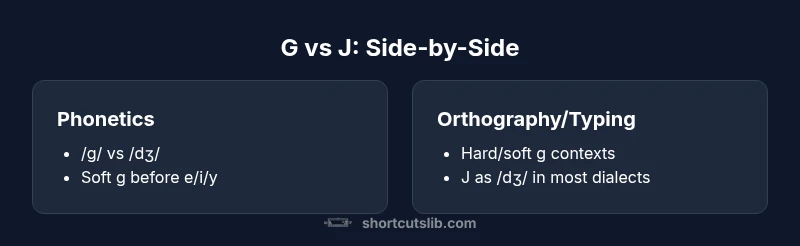
The g and j difference in phonetics centers on where the sounds originate and how freely they shift before different vowels. The hard g /g/ occurs before back vowels (go, garden) and in many consonant clusters (glow, gravity). The soft g typically surfaces as /dʒ/ before e, i, or y (giraffe, giant, gesture), and in several loanwords as in 'genre' where the sound can be /ʒ/ in some dialects. The letter j primarily represents the /dʒ/ sound as in jam and judge, though some dialects or languages may render it differently (e.g., French). These patterns influence both spelling choices and pronunciation guidance when teaching g and j difference. Real-world examples help: compare go vs gene, or jail vs giant. The key takeaway: g and j difference matters most for phonetic accuracy when the same letter cluster appears in early syllables or borrowed words.
Orthography: hard g vs soft g, and before e, i, y
Orthography shaping the g and j difference centers on when g is hard (as in go) and when it is soft (as in giraffe or general) before e, i, or y. Spelling patterns explain why we write 'giant' with soft /dʒ/ sound and why 'genuine' uses /dʒ/ before vowels. In contrast, the letter j represents a single primary sound across many English varieties: /dʒ/. This clarity helps learners remember rule-based exceptions. Common patterns include g before back vowels (go, garden) versus front vowels (giant, gentle) and the overarching tendency of j to behave uniformly in standard American and British English dialects. Recognizing these rules improves both decoding and encoding of written language.
The j letter: dedicated sound /dʒ/ and usage
The j letter serves a fairly stable phoneme in many languages, most notably English, where /dʒ/ is the standard value in words like jam, jewel, and journey. While some languages shift or reduce the sound, English keeps j tightly linked to /dʒ/. This contrast with g’s dual possibilities is a cornerstone of the g and j difference. In loanwords or language transfers, you may see variations (e.g., French /ʒ/ or /ʃ/ in borrowed terms). For practical writing, this means using j when the /dʒ/ sound appears and reserving g for its broader range of pronunciations.
Typographic and keyboard considerations
Beyond sound and spelling, the g and j difference extends to typography and typing. On a standard QWERTY keyboard, g and j live on opposite hands and carry distinct tactile cues (the bumps on the home-row keys aid aim and speed). This physical arrangement affects typing workflows when you practice words containing g or j. From a typographic perspective, lowercase g and j have distinct shapes—g’s loop and j’s tail can influence readability and line height in dense text. Designers and educators can leverage these differences to teach proper placement, improve typing fluency, and reduce errors in professional writing, coding, or transcription work.
Historical origins and evolution
The g and j letters trace a long linguistic history. G originated as a variant of C during early Latin script, which evolved into the modern form to represent the /g/ sound. J emerged later as a distinct form of I in medieval scripts to separate vowel and consonant usage, gradually adopting the /dʒ/ sound in many languages, including modern English. Understanding this evolution helps explain why g has a broader phonemic portfolio while j tends toward a single core value. This historical perspective also clarifies how certain languages may map g or j differently in their respective phonologies.
Common pitfalls in spelling and pronunciation
Learners frequently mix up hard and soft g, especially when encountering words like 'go' vs 'genre' or 'giant' vs 'gem'. The soft g rule before e, i, and y can lead to mispronunciation if users apply hard g unintentionally. Confusion with j often arises from its frequent /dʒ/ sound and its limited orthographic variability across many dialects. For writers, misplacing g and j in borrowed terms or proper nouns is a common error. For typists, errors can occur when touch-typing quickly and omitting the correct letter due to similar shapes or neighboring keys. Awareness and repeated practice are essential to overcome these pitfalls.
Language-specific differences: g and j across languages
Different languages handle g and j differently. In Italian, the combination 'gi' is /dʒ/ in front of i, while in Spanish, 'g' between vowels can shift depending on the following vowel and tongue position, and the letter j often represents an /x/ or /χ/ sound. English uses j for /dʒ/ in most contexts, while g can be /g/ or /dʒ/ depending on the letter sequence that follows. These cross-language nuances matter for learners operating in multilingual contexts, especially for pronunciation coaching, spelling correction, and literacy education. A nuanced understanding of g and j difference across languages helps educators tailor instruction appropriately.
How to write and type g and j reliably
Reliable writing and typing of g and j require a blend of rule-based mastery and practical drills. Practice applying hard/soft g rules in common word families (go, giant, gift) while reinforcing the /dʒ/ sound of j in everyday vocabulary. Keyboard practice should emphasize the home-row alignment and the finger assignments for g and j, including the tactile bumps to ensure quick, accurate placement. Reading aloud while highlighting g and j occurrences can reinforce pronunciation patterns, while copying exercises that isolate tricky sequences can improve spelling accuracy. Tools that track progress over time support both phonetic improvement and typographic fluency.
Practice exercises: drills to reinforce g and j difference
A structured practice routine helps solidify g and j distinction. Start with a pronunciation drill: read a list of words containing hard g, soft g, and /dʒ/ sounds, paying close attention to the before-vowel environment. Add a spelling drill: sort words by g before e/i/y vs other contexts, and separate words that use j for /dʒ/. For typing, assemble short phrases of words containing g and j, focusing on accurate hand placement. Then introduce dictation exercises with sentences that gently force mucous of g and j across word boundaries. These drills, repeated over time, improve both speech and typing accuracy, reducing mispronunciations and spelling errors.
Real-world applications: writing, education, UI/UX
Understanding g and j difference has immediate value in education, content creation, and user interfaces. Teachers can design targeted pronunciation and spelling activities to address common trouble spots. Writers benefit from more precise spelling choices and improved readability. In UI/UX, clear typographic rules reduce cognitive load when reading pill labels, buttons, or help text containing g and j words. A solid grounding in g and j difference also informs instructional design for language learners, ensuring that resources reflect authentic pronunciation and accurate orthography.
Blended approach: recommended strategies
A blended approach that combines phonetic awareness, orthographic rules, and typing practice yields the best results. Start learners with a quick phonetics baseline, then layer in spelling rules and keyboard drills. Regular exposure to a mix of words with hard g, soft g, and /dʒ/ strengthens both decoding and encoding skills. For multilingual learners, provide language-specific notes on g and j usage, acknowledging how some languages map these letters differently. In practice, a well-balanced curriculum or self-study plan will integrate listening, speaking, reading, and typing activities around the g and j difference.
Comparison
| Feature | Phonetics-first approach | Orthography-first approach |
|---|---|---|
| Pronunciation clarity | High focus on phonemes and phonetic rules | High focus on spelling patterns and orthography |
| Learning curve | Moderate to high depending on language exposure | Moderate; more rule-based |
| Best for | Speech training and pronunciation improvements | Spelling accuracy and literacy development |
| Use cases in keyboarding | Helpful for dictation/voice-typing contexts | Helpful for typing consistency and keyboard training |
| Cross-language consistency | Consistent phonetic mapping across many languages | Less consistent due to orthographic variations |
| Resources | Phonetic guides, pronunciation dictionaries | Spelling and typography resources |
Pros
- Comprehensive coverage of phonetics, spelling, and typing
- Practical guidance for writers and typists
- Clear examples across languages
- Useful for educators and learners
Cons
- May be dense for those seeking quick tips
- Requires cross-disciplinary understanding (linguistics + typing)
- Not focused on a single language
A blended approach is best for most learners
Phonetics-first helps with pronunciation; orthography-first strengthens spelling. Combine both with typing practice for optimal mastery of g and j difference.
Questions & Answers
What is the g and j difference?
The g and j difference encompasses how these letters sound, spell, and are typed. G has multiple pronunciations (hard /g/ and soft /dʒ/ before certain vowels), while J predominantly represents /dʒ/ in English. Typing-wise, g and j occupy opposite hands on standard keyboards, with tactile cues that aid fast, accurate input.
G and J differ in sound and spelling; g can be hard or soft, while j is usually /dʒ/. On the keyboard, they sit on opposite hands, helping you type faster once you learn the layout.
How does g behave before e, i, or y?
G often becomes soft /dʒ/ before e, i, or y (as in giant, genuine). Exceptions exist, so memorize common words and refer to pronunciation guides for edge cases. This rule is central to the g and j difference in orthography.
G often sounds like /dʒ/ before e, i, or y, with some exceptions. Learn common words to master the pattern.
Is j always /dʒ/ across languages?
In English, yes, /dʒ/ is standard for j. Other languages may pronounce j differently (for example, /x/ in Spanish). When studying multiple languages, treat j as language-specific rather than universally /dʒ/.
In English, j is /dʒ/. In other languages, it can change, so check language-specific pronunciation guides.
How can I practice g and j typing on the keyboard?
Focus on the home row: left-hand for g and right-hand for j, using their tactile bumps to guide placement. Include words containing g and j, then escalate to sentences. Regular drills improve both speed and accuracy.
Use the home row and practice with g and j words, then sentences to boost typing speed and accuracy.
What are common spelling pitfalls with g and j?
Mixups often occur between hard and soft g contexts, or confusing borrowed terms where pronunciation diverges from spelling. Keep a reference list of rule-based words and check exceptions when in doubt.
Watch for hard/soft g rules and borrowed words where spelling and pronunciation diverge.
What practical applications hinge on g and j difference?
Understanding g and j difference improves pronunciation, spelling accuracy, and typing fluency. It benefits educators, writers, editors, and language learners by reducing error rates and increasing comprehension.
It helps with speaking, spelling, and typing accuracy in daily language tasks.
Main Points
- Identify hard vs soft g contexts first
- Remember j's standard /dʒ/ sound
- Use keyboard layout awareness for faster typing
- Be mindful of soft g before e, i, y
- Adopt a blended approach across phonetics, spelling, and typing