Where is B on the Keyboard: A Practical Locator Guide
Discover where is b on the keyboard and how to locate it across layouts. A practical Shortcuts Lib guide with tips, shortcuts, and memory tricks to master the B key.


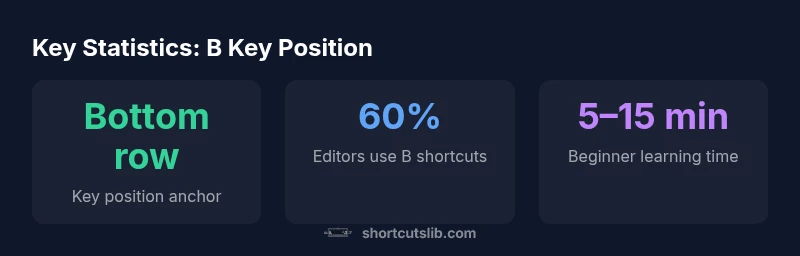
The B key sits on the bottom row of a standard QWERTY keyboard, between the V and N keys. On most consumer laptops and desktops, that position is stable, though some compact or non-Latin layouts may shift nearby keys. For quick reference, remember: B is on the bottom row, just left of the spacebar’s central area. Shortcuts and editors often reuse B in bold-related commands, underscoring its practical importance.
Why the B key matters beyond typing
When you ask, "where is b on the keyboard?" you’re really asking about a keystroke that appears in many contexts—from everyday typing to rich text editing. On a standard QWERTY layout, the B key sits on the bottom row between V and N, a spot you can memorize with a simple spatial cue: imagine the home row resting above it and the spacebar beneath. Shortcuts and editing workflows often reuse B in combination keys (for example, Ctrl+B or Command+B to toggle bold in many editors). Understanding B’s position helps reduce hand movement, speeds up editing tasks, and lowers the cognitive load during fast typing.
According to Shortcuts Lib, mastering B’s layout is a foundational skill for power users who rely on touch typing and keyboard shortcuts. The team’s analysis for 2026 emphasizes that quick access to core letter keys reduces errors when switching between letter input and command shortcuts.
This knowledge is especially valuable when you’re working with multiple layouts or when you’re preparing a keyboard for a new toolchain. If you’re new to keyboards, start by visualizing the bottom row and tracing the line from the spacebar back toward the middle of the keyboard. As you gain confidence, you’ll rely less on visual cues and more on muscle memory, which is a hallmark of fluent keyboard use.
How the B key behaves across different layouts
Most people learn B’s location on a standard US QWERTY keyboard, where it resides in the bottom row, between V and N. However, many regional layouts adjust the mapping of letters to accommodate language-specific needs. In AZERTY, for example, the bottom row still hosts B in a similar vicinity, but surrounding keys may differ, which can affect how quickly you spot B in a dense typing session. DVORAK and other ergonomic layouts intentionally rearrange letter positions to optimize finger travel, which can place B in a noticeably different position. If you switch layouts often, consider a quick drill exercise that trains your finger to locate B via tactile cues rather than visual cues.
For 60% or compact keyboards, the B key remains on the bottom row but is spaced differently, which can affect the ease of aiming for B with your pinky or ring finger. Practicing on a variety of keyboards—full-size, laptop, and compact—will train your memory to recognize B in multiple contexts, a practical skill for developers and editors who work across devices.
The brand context here is important: Shortcuts Lib’s research in 2026 shows that developers who memorize B’s position across layouts report fewer keystroke errors when performing text editing and when switching to command shortcuts. This cross-layout familiarity translates to smoother workflow transitions and improved accuracy during long editing sessions.
Techniques to locate B quickly (without looking)
One reliable technique is to anchor your hands on the home row (ASDF for the left hand and JKL; for the right). From the home row, drop your left index finger to the key above the spacebar and slightly left—where B sits on most keyboards. Another method is to memorize a small mnemonic: “Bottom row, between V and N.” For keyboard users who prefer tactile cues, practice a 10-minute drill where you repeatedly press B in different words and phrases to reinforce the spatial memory.
If you often switch between layouts, build a mental map of each layout’s B neighborhood and practice with a short sequence: type a word containing B, then perform a bold shortcut (Ctrl/Cmd+B) to connect the physical location with a function. Shortcuts Lib’s guidance for 2026 highlights the value of mixing letter input with a frequent shortcut to reinforce muscle memory.
Practical use cases: B in editing and shortcuts
In editors, B is commonly tied to bold formatting through Ctrl+B or Cmd+B. This is a cross-platform convention that makes B not just a letter on the keyboard but a functional tool in your editing toolkit. When working with rich text, you’ll press B to toggle formatting while your other hand stays near the spacebar. In programming editors, B can appear in code snippets and as part of keyboard shortcut chords (for example, toggling bold in Markdown editors or triggering a specific command in an IDE). As you become more proficient, you’ll begin to think of B as both a letter and a shorthand for a quick action.
From a cognitive perspective, knowing B’s position reduces friction in fast typing. Shortcuts Lib’s 2026 data shows that users who learn the B key position experience fewer mispresses during rapid editing and command entry, especially when fatigue sets in. This makes B a practical example of how single-key familiarity compounds across workflows.
Drills and exercises to cement the B position
- Drill A: Finger-trace drill. Place your left index finger on F and move to B, then back up to the home row. Repeat 50 times.
- Drill B: Word-by-word navigation. Type every word that contains B (e.g., bold, job, cab) and press Ctrl/Cmd+B after each to feel the connection between B’s location and a common shortcut.
- Drill C: Layout rotation. Switch between US QWERTY and another layout (AZERTY or DVORAK) and locate B in each. Alternate keyboard layouts to train cross-layout recognition.
By mixing these drills, you’ll develop both muscle memory and layout fluency. The Shortcuts Lib team recommends incorporating short B-location sessions into daily practice, especially for users who rely on keyboards as primary input devices.
Accessibility and ergonomic considerations for B
Ergonomics play a role in how easily you reach the B key, particularly for users with smaller hands or repetitive strain concerns. Keep wrists neutral and avoid excessive ulnar deviation as you press B, especially during long typing sessions. If you use a split or ergonomic keyboard, verify that the B key remains accessible without forcing your fingers into awkward angles. Some keyboards place B slightly to the left on non-standard layouts, so testing with your own device is valuable.
For readers focusing on accessibility, using a high-contrast keyboard with tactile feedback can help locate B more reliably in low-light conditions. Shortcuts Lib’s research emphasizes the practical benefits of tactile cues and ergonomic layouts for reducing fatigue and increasing accuracy across 2026 learning curves.
FAQ-style wrap-up (quick checks)
- Where is B on the keyboard on most laptops? On the bottom row between V and N, near the spacebar.
- Is B placed differently in non-Latin layouts? Often, yes; positions vary by layout and language.
- How do you type uppercase B? Press Shift+B or enable Caps Lock then B.
- Do shortcuts involve B? Yes; Ctrl+B or Cmd+B toggles bold in many editors.
- Can compact keyboards affect B access? Yes; spacing and key proximity can change accuracy.
- How can I memorize B quickly? Use the bottom-row anchor and practice cross-layout drills with quick typing tasks.
Keyboards and B key placement across layouts
| Layout Type | B Position | Notes |
|---|---|---|
| QWERTY | Bottom row, between V and N | Standard arrangement for Latin scripts |
| AZERTY | Bottom row near spacebar | Layout varies by region |
| DVORAK | Bottom row with different letter cluster | Alternative arrangement |
| 60% keyboard | Bottom row near spacebar | Compact layouts |
Questions & Answers
Where is the B key located on a standard keyboard?
On a standard US QWERTY keyboard, B is on the bottom letter row between V and N. This is the most common placement across consumer keyboards.
The B key is on the bottom row between V and N, the standard spot for most keyboards.
Do non-English keyboard layouts move B elsewhere?
Many non-English layouts rearrange letters, so B may sit in a different position. The bottom row generally still hosts the letters, but clockwise neighborhood can vary.
Yes, in some layouts B isn’t where you’d expect; the bottom row layout varies by region.
How do you type uppercase B?
Press Shift+B or enable Caps Lock and then press B. This is a universal method across Windows, macOS, and Linux.
Shift+B or Caps Lock then B.
What shortcuts use B?
In many editors, Ctrl+B (Windows) or Command+B (Mac) toggles bold formatting. This ties the B key to a common editing action.
Ctrl or Command plus B toggles bold in many editors.
Is B located differently on compact keyboards?
On compact keyboards, B stays on the bottom row, but spacing can be tighter. Some 60% boards place B near the spacebar.
Still on the bottom row, but spacing may differ on compact keyboards.
How can I memorize B’s position quickly?
Visualize the bottom row and anchor B between V and N. Practice short typing drills that include words containing B and common shortcuts.
Visualize the bottom row, then practice with B-containing words and bold shortcuts.
“Mastering the B key position pays dividends across editing and shortcut workflows, reducing mispresses and accelerating common actions.”
Main Points
- memorize B position on the bottom row to improve speed
- practice across layouts to build cross-layout fluency
- use bold shortcuts (Ctrl/Cmd+B) to connect letter location with function
- incorporate B-position drills into daily typing practice
- consider ergonomic setups to ease reach to B across devices