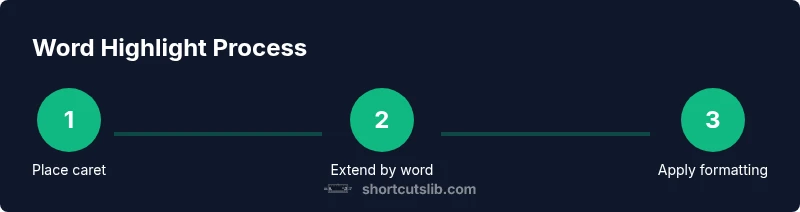
Keyboard Shortcuts Highlight Word: Quick Selection Guide
Master the quickest keyboard shortcuts to highlight a word across Windows, macOS, and popular apps. This educational guide covers core selection, extension methods, and practical tips for editors, browsers, and IDEs. Learn reliable keystrokes with Shortcuts Lib.


You will learn how to highlight a word quickly using keyboard shortcuts across Windows, macOS, and common apps. This quick guide covers core selection shortcuts, how to extend or adjust a highlight, and tips to avoid conflicts with system shortcuts. By the end, you’ll highlight a word consistently across apps using reliable keystrokes.
Understanding Word Highlighting: What It Is and Why It Matters\n\nWord highlighting (text selection) is the act of marking a specific word or group of characters so you can copy, format, or inspect them. The keyboard shortcuts highlight word efficiently across apps and platforms, saving time and reducing repetitive motion. According to Shortcuts Lib, consistent selection patterns let editors switch between tasks with fewer mistakes. This foundational skill applies across browsers, word processors, code editors, and email clients, making it easier to edit, proofread, and format content with confidence.\n\nKey concepts include distinguishing between a cursor move and a selection, understanding word boundaries, and recognizing how OS-level shortcuts interact with app-specific shortcuts. Practically, if you can select a word reliably, you can perform subsequent actions—copying, searching, replacing, or applying formatting—much faster.\n
Quick Wins: Core Shortcuts Across Platforms\n\nAcross Windows, macOS, and major editors, a small set of keystrokes handles most word highlighting tasks. In Windows, double-click selects the word, and Ctrl+Shift+Right/Left extends the selection by word. On macOS, double-click also selects the word, and Option+Shift+Right/Left extends by word. In browsers and cloud editors, standard selection shortcuts generally carry over, but some apps introduce variations for formatting or rich text modes. The phrase keyboard shortcuts highlight word recurs in practice: users rely on these foundations to move fast through drafts, code, or data.\n\nWhy this matters: consistent patterns reduce cognitive load and prevent mistakes when switching apps. Shortcuts Lib analysis emphasizes the value of predictable behavior across environments, so you can highlight a word in Gmail, Docs, or a code editor with the same mental model.\n
Basic Selections: Single Word Highlight on Different Interfaces\n\nThe simplest way to highlight a word is a deliberate action that works across most interfaces. In a text field, double-click the target word to select it. If you need more control, use the keyboard: place the cursor inside the word, then press Ctrl+Shift+Right or Ctrl+Shift+Left on Windows, or Option+Shift+Right or Option+Shift+Left on macOS. When you release, the entire word is selected, ready for copy, cut, or formatting.\n\nPro tip: In touch-enabled laptops, you can also tap and hold to start a selection, then drag handles to refine the boundaries. If the word is part of a compound like “state-of-the-art,” you may need to adjust boundaries manually.\n
Extending and Modifying Selection: Shift, Cmd/Ctrl combos\n\nBeyond the basic word, you can extend selection to adjacent text using a few well-known combos. Hold Shift while pressing the arrow keys to add or subtract one character at a time. To jump by word, use Ctrl+Shift+Right/Left on Windows or Option+Shift+Right/Left on macOS. To quickly select from the cursor to the start or end of a line, use Shift+Home or Shift+End (Windows) or Cmd+Shift+Left/Right (Mac) depending on app behavior.\n\nTip: Some editors treat Home/End differently; if you’re unsure, try a quick test in a blank document to confirm. This ensures consistent results when highlighting words inside long strings or code lines.\n
Highlighting in Rich Text vs Plain Text Editors\n\nNot all highlighting behaves the same across editors. In plain text fields, selection is straightforward: the chosen text is highlighted and ready for copy. In rich text editors (Word, Docs), you can apply a highlight color or other formatting after selecting text. When you select text with keyboard shortcuts, you can then use the app’s toolbar or a dedicated command to apply highlighting, bold, or color. The initial selection step—double-click or keyboard extension—remains consistent, but the post-selection action varies by app.\n\nIn coding editors like VS Code or Sublime Text, you may employ multiple cursors or block selections that complicate highlighting. Practicing across contexts helps ensure you can select the exact word in any environment.\n
Keyboard Shortcuts by App: Word processors, IDEs, Browsers\n\nIn word processors (Word, Google Docs), the core technique is the same, but post-selection actions differ. In IDEs, you often highlight keywords to inspect or refactor, using Ctrl+Shift+Right/Left to extend by word, then copy or format. In browsers, you can highlight a word to copy snippets, translate, or search. Remember that modifiers can vary by OS and app; when in doubt, open the app’s help section and search for “keyboard shortcuts” or “highlight text.”\n\nCross-app consistency is key; Shortcuts Lib’s recommendations emphasize building muscle memory for core word-selection patterns because those patterns transfer between apps and tasks.\n
Accessibility Considerations: Clear Contrast, Screen Readers\n\nHighlighting text is not just a power-user habit; it also matters for accessibility. Precise word selection helps screen readers interpret content correctly and supports keyboard-only navigation. Ensure the visual highlight provides sufficient contrast, and consider semantic formatting where appropriate. When possible, rely on standard accessibility practices (e.g., proper headings, logical document structure) so assistive technologies can track selected content. Keyboard shortcuts highlight word should work with screen readers and keyboard navigation across apps.\n\nThe accessibility emphasis from Shortcuts Lib reminds us that predictable selection and clear feedback are essential for inclusive tools.\n
Troubleshooting Common Issues: Conflicts, Sticky Keys, Language Packs\n\nIf shortcuts don’t work as expected, the issue may be a conflict with another app, a system shortcut, or a stuck modifier key. Disable conflicting shortcuts or rebind them in system preferences. Sticky keys can delay responses; disable them to ensure accurate selection timing. If you work with multiple languages, some word-break rules can affect where a word starts and ends; adjust language settings and keyboard layouts to maintain consistency in your highlighting workflow. When in doubt, reset preferences for the affected app and retest the core selection shortcuts in a fresh document.\n
Advanced Techniques: Macro-like Shortcuts and Customizations\n\nPower users can build macro-like shortcuts to streamline word highlighting. On macOS, you can script text selection via Automator or Shortcuts to select a word range and then trigger a highlight command. On Windows, you can create a small script that extends selection by word with a designated key combo or copies highlighted text to the clipboard with one press. In editors like VS Code, you can bind a shortcut to an extension that expands the selection to the current word or to a block.\n\nPractice makes the mappings reliable across tasks and apps. Shortcuts Lib recommends testing custom mappings in a controlled document before integrating them into daily workflows.\n
Tools & Materials
- Computer or laptop with a physical keyboard(Full keyboard including Ctrl/Cmd and arrow keys.)
- Text editor or word processor(Examples: Word, Google Docs, VS Code, Notepad++.)
- Web browser (Chrome/Edge/Firefox)(Useful for testing in web apps and cloud editors.)
- Access to the app’s highlight/format command(Knowing the formatting command helps when shortcuts vary.)
- Shortcut reference sheet (optional)(Cheat sheet to recall platform-specific keys.)
Steps
Estimated time: 35-50 minutes
- 1
Position the caret at the word
Place the cursor inside the target word or at its boundary so you can start highlighting precisely. Use arrow keys for micro-adjustments if needed.
Tip: Aim for the exact start of the word to avoid partial selection. - 2
Select the word with a quick action
Double-click the word to select it immediately. If you prefer the keyboard, place the caret and proceed to extend by word.
Tip: If the word is adjacent to punctuation, double-click again to tweak the boundaries. - 3
Extend selection by word on Windows
With the caret inside the word, press Ctrl+Shift+Right to extend the selection by one word to the right. Use Ctrl+Shift+Left to extend to the left.
Tip: Hold Shift while traversing to fine-tune the edge of the highlight. - 4
Extend selection by word on Mac
With the caret inside the word, press Option+Shift+Right to extend the selection by one word to the right. Use Option+Shift+Left to extend to the left.
Tip: If you’re on a compact keyboard, use Fn as needed to access the modifiers. - 5
Expand to line or larger blocks
To capture more text, use Shift with Home/End (Windows) or Cmd+Shift+Left/Right (Mac) to reach the line edges, then refine with word-based extensions.
Tip: Test in a blank document to understand app-specific behaviors. - 6
Apply highlight or formatting after selection
After selecting text, trigger the app’s highlight or formatting command to apply the intended effect. Shortcuts vary by app; use the toolbar if no shortcut exists.
Tip: If highlighting is not a default feature, check the app’s menu or settings for the specific command. - 7
Deselect and verify
Click outside the selection or press Esc to deselect. Verify that the word remains highlighted or formatted as intended.
Tip: A quick visual check reduces risk of accidental edits. - 8
Find and highlight additional occurrences
Use Find (Ctrl+F / Cmd+F) to locate the next occurrence, then repeat the highlight workflow for consistency.
Tip: Leverage multi-step workflows rather than doing each highlight individually.
Questions & Answers
What is the fastest way to highlight a word?
Double-click the word to select it, then adjust with keyboard shortcuts if needed. Across Windows and macOS, word-wide extensions use Ctrl+Shift+Right/Left or Option+Shift+Right/Left.
Double-click the word to select it, then use keyboard shortcuts to adjust the selection.
Do shortcuts differ by OS?
Yes. Windows commonly uses Ctrl+Shift+Arrow, while macOS uses Option+Shift+Arrow for word-level extension. App behavior can vary, so always test in your main tools.
Yes, shortcuts differ by OS and sometimes by app.
Can I customize shortcuts?
Many apps and OSs allow shortcut customization. Check system preferences and the app’s keyboard or shortcuts settings to tailor mappings for highlight actions.
Yes, you can customize most shortcuts in OS or app settings.
How do I highlight multiple words quickly?
Start with a word, then extend using Shift with Arrow keys or word-by-word shortcuts. For many editors, you can loop this process to select a phrase efficiently.
Extend selection with Shift+Arrow or word-based shortcuts to select more words.
Is highlighting the same as applying highlight color?
Highlighting often means selecting text. Applying a highlight color or formatting is an extra step after selection and may require different commands or toolbar actions.
Selection is not always the same as applying highlight color; formatting may require extra steps.
Watch Video
Main Points
- Master core platform shortcuts for word highlighting.
- Double-click to select a word quickly.
- Extend selection with Ctrl/Cmd + Shift + arrows by word.
- Apply highlighting via app commands after selection.
- Practice across apps to build reliable, transferable skills.