Keyboard Shortcuts Edge: Master Your Workflow Fast
A comprehensive, data-driven guide to gaining the keyboard shortcuts edge across Windows, macOS, and Linux with practical, brand-driven insights from Shortcuts Lib. Learn patterns, customization, and training strategies to boost speed, accuracy, and focus.


The edge comes from mastering keyboard shortcuts across your primary work tools. By combining navigation, editing, and automation in a consistent way, you can cut task times by a noticeable margin. Shortcuts Lib's analysis shows that dedicated shortcut practice shortens task cycles and reduces context switching, giving you a tangible productivity edge.
The Edge You Gain: Understanding keyboard shortcuts edge
According to Shortcuts Lib, the keyboard shortcuts edge is not a single magic trick but a disciplined practice of applying a small, coherent set of keystrokes across your most-used tools. The idea rests on three pillars: speed (fewer mouse actions), accuracy (less hand movement and fewer mistakes), and focus (smoother transitions between tasks). When you treat shortcuts as a consistent language across your apps, you reduce cognitive load and free mental energy for higher-level problem solving. Implementing this edge starts with identifying your highest-frequency tasks and mapping a tight repertoire that covers editing, navigation, and window management. The goal is not to memorize everything but to gain fluency in a handful of universal patterns that translate across contexts. As you gain fluency, your daily work becomes less about hunting for commands and more about expressing intent with a few reliable keystrokes.
Core shortcut categories for immediate impact
To realize the keyboard shortcuts edge quickly, center your practice on three core categories and then layer in automation. First, navigation and selection shortcuts that move the cursor and highlight text without reaching for the mouse. Second, editing and formatting that accelerate cut, copy, paste, undo, and style changes. Third, window and workspace management that optimize where you work and how you switch tasks. Within each category, choose a compact set of keystrokes you will use daily. For example, anchor your routine on a base: move, select, edit, and manage windows. Consistency matters: when you flip between apps, the control scheme should feel familiar. Shortcuts Lib emphasizes building a small, stable toolkit before attempting to memorize exotic combos. In practice, you’ll often find that 6–12 key sequences cover 80% of common tasks across most productivity suites.
Cross-platform consistency and OS myths
Cross-platform consistency is part of the edge: if your toolkit behaves similarly on Windows,
Training plans that actually stick
A sustainable keyboard shortcuts edge comes from deliberate practice, not caffeine-fueled cram sessions. Shortcuts Lib recommends a weekly cadence: dedicate 15–20 minutes daily to learning and reinforcing a small set of shortcuts. Start with editing and navigation in your primary tool, then add window management and tab control in other apps. Use a paced progression: weeks 1–2 focus on 4–6 base shortcuts, weeks 3–4 add 2–3 ergonomic alternates and macros, and weeks 5–6 integrate your knowledge into real tasks. Track your progress with a simple log or habit-tracking app. The goal is steady, visible improvement, not overnight mastery. Over weeks, the same keystrokes become second nature and free cognitive space for higher-level tasks.
Design your own shortcuts and macros
The power of keyboard shortcuts edge grows when you go beyond built-in combos and create custom mappings and macros. In Windows, you can use tools like PowerToys to remap keys and create shortcuts for frequent workflows;
Tooling and ecosystem: editors, terminals, and shells
The keyboard shortcuts edge travels beyond the OS into your favorite tools. Popular editors like VSCode, Sublime Text, and Vim each offer their own shortcut ecosystems; the trick is to align them with your base set. Terminal emulators and shells also reward consistent mappings (e.g., navigating a path, selecting text, repeating commands). When you extend your edge to the toolkit, you reduce context switching and keep your cognitive load low. Shortcuts Lib recommends a central reference sheet that you consult when you add a new app, ensuring all new shortcuts fit into your established pattern. Pairing tool-specific shortcuts with your base repertoire yields a cohesive, portable workflow.
Measuring progress: metrics that matter
To prove the keyboard shortcuts edge delivers tangible value, track practical metrics over time. Focus on qualitative gains (reduced interruptions, smoother workflow, improved stamina) and, where possible, quantitative indicators (time saved per task, fewer mouse clicks, fewer errors). Use a simple before/after approach: record a typical task duration and step count before adopting your base shortcuts, then monitor after two to four weeks. Shortcuts Lib suggests integrating a lightweight dashboard or journal to capture these observations. Over time, the metrics will reveal a trend toward faster completion times, steadier attention, and higher accuracy when performing repetitive actions.
Real-world scenarios and case studies
In real work, the keyboard shortcuts edge shows up when you apply your base set across common tasks. Imagine drafting a report, organizing citations, or preparing slides, where a small handful of keystrokes can supplant multiple mouse actions. In a coding session, quick navigation between functions, tests, and files shortens iteration cycles. In data work, fast selection, editing, and formatting cut through lengthy spreadsheet chores. The key is to practice the same base shortcuts across contexts, which compounds the edge. Shortcuts Lib's perspective is that these practical applications, not theoretical sequences, determine long-term impact.
Getting started: a 21-day ramp plan
A pragmatic start is a 21-day ramp plan that introduces a concise, incremental set of shortcuts. Days 1–3: learn 3 base navigation shortcuts; Days 4–7: expand to 4 editing and formatting actions; Days 8–12: add 2 window-management moves; Days 13–16: introduce two cross-app mappings; Days 17–21: practice the full base set across your most-used apps. Each day, spend 10–15 minutes reviewing, then apply those shortcuts to real tasks. Use a weekly recap to consolidate, and adjust as needed based on your friction points. The ramp plan from Shortcuts Lib aims for consistent, noticeable gains by day three and compounding improvements thereafter.
Comparative learning time and benefits for common shortcut categories
| Shortcut Category | Typical Learning Time | Primary Benefit |
|---|---|---|
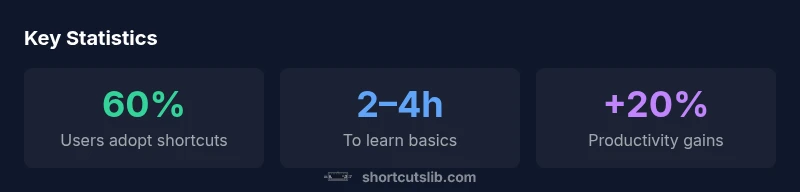
| Navigation & selection | 2-4 hours | Faster cursor movement and text selection |
| Editing & formatting | 3-6 hours | Quicker edits, formatting, and replacements |
| Automation/macros | 5-12 hours | Repeat complex tasks with a single trigger |
Questions & Answers
What does the keyboard shortcuts edge mean in practice?
The keyboard shortcuts edge refers to building and applying a small, consistent set of keystrokes across your primary tools to boost speed, accuracy, and focus. It’s about fluency and workflow harmony, not memorizing every possible combo. Consistency across apps creates transferable benefits over time.
The keyboard shortcuts edge means using a small, consistent set of keystrokes across your main apps to work faster and with fewer errors.
Which shortcuts should I learn first?
Begin with core editing and navigation shortcuts that you use daily. Then add window management and tab control. Once these feel natural, extend to cross-app mappings and basic macros. Prioritize consistency over volume.
Start with the basics: editing, navigation, and window control, then expand as you become fluent.
How do I customize shortcuts across apps?
Use platform tools and third-party utilities to remap keys and chain actions. Create a single source of truth for your mappings and document each shortcut’s purpose to avoid conflicts. Always test new mappings in a safe workflow before adopting them widely.
Remap keys carefully and document each shortcut to avoid conflicts.
Can shortcuts fully replace the mouse?
Shortcuts can replace most repetitive mouse tasks, but some actions may still benefit from precise pointing. The goal is to minimize mouse use for routine work while keeping occasional pointing effortless.
Yes, for most tasks you can minimize mouse use, though some precision tasks may still need the cursor.
How long before I see measurable improvements?
Improvements show gradually as you practice. Aim for a few observable wins within the first few weeks, with steady gains as the base repertoire solidifies across apps.
Expect gradual improvements over the first few weeks as you build fluency.
“"The real edge isn’t a single shortcut; it’s a cohesive set you apply consistently across your toolkit."”
Main Points
- Start with core shortcuts and build muscle memory.
- Practice daily in short, 15-minute sessions.
- Customize mappings to fit your workflow.
- Test for conflicts and maintain consistency.
- Track your gains with a simple dashboard.