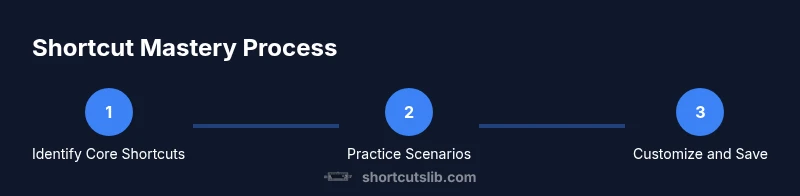
Master Blender Keyboard Shortcuts: A Practical Guide
Learn essential Blender keyboard shortcuts to speed up modeling, shading, and animation. This practical guide from Shortcuts Lib covers navigation, selection, transformation, and customization tips to boost your workflow.


According to Shortcuts Lib, mastering keyboard shortcuts blender can dramatically speed modeling, sculpting, shading, and animation. This guide covers essential navigation, selection, transform, and viewport shortcuts, with practical examples and OS-specific tips. You’ll also learn how to customize keys for your workflow, drawing on proven patterns from Shortcuts Lib. Whether you’re a beginner or power user, these fundamentals lay the groundwork for faster, more accurate work.
Why Blender Keyboard Shortcuts Matter
In the world of 3D work, keyboard shortcuts blender are more than conveniences — they’re performance levers. Proficiency with shortcuts reduces the friction between a user’s intention and the resulting action, letting you iterate quickly and stay focused on creative decisions. Shortcuts accelerate core tasks like navigation, selection, and transformation, which are the daily bread of modeling, sculpting, shading, and animation. When you adopt a consistent shortcut vocabulary, you spend less time hunting through menus and more time building. Shortcuts Lib highlights that a deliberate, learnable shortcut system not only speeds tasks but also lowers cognitive load, so you can think about design rather than button-hunting. This section sets the foundation for a repeatable, scalable workflow in Blender.
Note: The term keyboard shortcuts blender is used throughout this article to reinforce the exact topic and to support search discovery. Practicing with a curated set of core shortcuts first makes it easier to expand to advanced patterns later. Tools like a well-organized keymap and a dedicated cheat sheet help maintain consistency as your projects grow.
Core Navigation Shortcuts
Navigation shortcuts form the backbone of efficient Blender work. The most impactful actions include viewport orbit, pan, and zoom, plus quick view toggles that keep you oriented during complex scenes. The common navigation trio—orbit, pan, and zoom—lets you inspect models from any angle without breaking your flow. In practice, you’ll rely on keyboard commands to jump between views, reset the camera, and quickly frame your subject. For all users, a solid plan starts with a stable mental map of navigation shortcuts and a habit of using them as your first instinct. As you train, you’ll notice that keyboard shortcuts blender enable faster perspective changes than mouse-only navigation, which is why Shortcuts Lib emphasizes consistent practice.
Key idea: Build muscle memory by repeating a small, focused set of nav shortcuts during every project session. This reduces the distance between intention and action and gradually eliminates menu explorations.
Modeling Shortcuts You Should Know
Modeling shortcuts are the core toolkit for shaping geometry efficiently. Begin with the basics: moving, rotating, and scaling with G, R, and S, respectively. Nudge transforms using precise input, but the power comes from combining transforms with axis constraints (X, Y, Z) and contextual commands like duplicate (Shift+D) and delete (X). Add to that selection shortcuts (A to select all, Alt+A to deselect) and loop tools (Ctrl+R) for quick topology work. As you deepen your practice, you’ll rely on extrusion (E), beveling (Ctrl+B or F for face operations in newer iterations), and knife operations (K). Consistency matters here: map a logical pattern from one tool family to another and keep the same mental model across tasks. This consistency makes complex edits feel like a natural extension of your hands.
In the context of Blender, remember that keyboard shortcuts blender aren’t just fast keys; they’re an integrated way to express your intent directly to the software without interrupting your creative rhythm. Shortcuts Lib’s approach is to start with a tight core set and expand as you gain confidence.
Shading, UV Editing Shortcuts
Shading and UV work rely on a parallel set of shortcuts that streamline material creation and texture mapping. Enter shading mode, switch between vertex/edge/face selections, and use unwrap commands to lay out UVs efficiently. Common actions include toggling into texture painting, applying smooth shading, and quickly switching editor types with the tilde (~) and numeric pad keys. For UV work, use U to unwrap, and Ctrl+V to apply paste-like operations in advanced contexts. While the details of shading workflows can be deep, the core idea remains: a coordinated set of shortcuts reduces context switching and helps you stay focused on pixel-level quality.
Blender users who lean on keyboard shortcuts blender typically organize their shading and UV workflows around a few core keystrokes and a clean, repeatable sequence. Shortcuts Lib encourages practitioners to document their own pattern library so they can recall and adapt it to different materials and lighting setups.
Customizing Shortcuts for Your Workflow
Customization is where many users achieve true productivity gains. Blender’s Preferences > Keymap panel lets you tailor, pin, or add shortcuts for virtually every action. Start by identifying the tasks you perform most, then map a consistent keyboard pattern to those actions. When customizing, avoid duplicating existing shortcuts to prevent conflicts; instead, reassign or disable conflicting mappings. After changes, save your keymap and test across a few representative tasks to ensure the new mappings feel natural. If you work on multiple machines, export and import your keymap to preserve consistency. Shortcuts Lib recommends maintaining a personal keymap file as part of your project setup, so your favorite patterns travel with your work.
OS-Specific Considerations and Accessibility
OS differences influence how shortcuts behave, especially regarding modifier keys. On
Practice Scenarios to Build Muscle Memory
Turn theory into habit by applying shortcuts in short, focused drills. Create mini-tasks that require navigation, selection, and a sequence of modeling actions, then repeat with variations. For example, reproduce a simple shape using a core set of transforms, then switch to a different topology using extrude, inset, and bevel. Repetition across settings and files cements memory and improves speed. Keep a log of your progress and steadily expand the short list of actions you’re comfortable executing without looking. Shortcuts Lib emphasizes gradual, mindful practice as the most reliable path to real proficiency.
Troubleshooting Common Shortcut Conflicts
Shortcuts conflicts can derail momentum. If a key combination triggers an OS-level action or a different Blender command than intended, first check the Keymap for duplicates. If a system shortcut remains active, consider reassigning the Blender action to a different key or disabling the OS shortcut at the OS level. When collaborating on projects, agree on a shared shortcut set to avoid cross-user conflicts. Maintaining a clean, conflict-free keymap is essential for consistent, reliable performance.
Tools & Materials
- Blender software (latest stable)(Download from blender.org; ensure it's installed and accessible)
- Computer with Blender-compatible OS(Windows, macOS, or Linux; ensure system is functional and up-to-date)
- Ergonomic keyboard(Consider programmable keys for extended shortcuts)
- Mouse or pen tablet(Precision input improves modeling and UV work)
- Note-taking tool(Log your own shortcut patterns and tweaks)
- OS-specific shortcut reference sheet(Helpful for cross-OS workflows)
Steps
Estimated time: 45-60 minutes
- 1
Open Blender
Launch Blender and prepare to review or customize your keymap. While the app loads, take a moment to consider which tasks you perform most frequently and how shortcuts could streamline them. This step sets the tone for faster iteration later.
Tip: Have a quick reference sheet ready for the core set you’ll adopt first. - 2
Open Preferences to Keymap
Navigate to Edit > Preferences > Keymap. Scan the default mappings to identify the most-used actions in your typical workflow, and note any obvious conflicts you want to avoid when reassigning keys.
Tip: Export your current keymap before making changes so you can revert easily. - 3
Practice viewport navigation
Calibrate navigation shortcuts by orbiting, panning, and zooming with your keyboard and mouse. Use Numpad-based quick views and verify you can reframe the camera without leaving the keyboard.
Tip: Consciously pair each view with a single key combo to build consistent recall. - 4
Master core modeling actions
Focus on the G, R, S transform trio, combined with axis constraints (X, Y, Z). Add E for extrusion and I for inset where relevant. Practice a short sequence that modifies a cube into a simple shape using only these actions.
Tip: Keep a small practice file to repeat the sequence until it becomes second nature. - 5
Tackle shading and UV steps
Switch to shading and UV editors, unwrap with U, and switch between material nodes with simple, repeatable keys. Build a basic material and apply it to your geometry to reinforce the workflow.
Tip: Document your preferred material-related shortcuts for quick recall. - 6
Customize and save your keymap
Add new mappings for high-frequency actions, disable duplicates, and save the keymap. If you work across machines, export the keymap and re-import when you set up a new environment.
Tip: Label new shortcuts clearly in your notes so you remember the rationale behind each assignment.
Questions & Answers
What are the most essential Blender shortcuts for beginners?
Begin with navigation and selection: view controls, select/deselect tools, and transform actions (G, R, S). Learn extrusion (E) and basic mesh editing to start building functional workflows. As you grow, expand to context-specific shortcuts for shading and UVs.
Start with navigation, selection, and transform shortcuts, then add extrusion and basic mesh editing to build your workflow.
How do I customize Blender shortcuts?
Open Preferences > Keymap to modify existing shortcuts or add new ones. Avoid duplicates and export your keymap for safety. Test changes on representative tasks before adopting them widely.
Open Preferences, adjust the keymap, and back it up before testing on real projects.
Are Blender shortcuts OS-specific?
Yes. Mac uses Command in many cases where Windows uses Ctrl, and some modifiers differ by platform. Consider separate keymaps or explicit notes so your muscle memory stays accurate when switching OS.
Yes, there are OS-specific differences; keep notes or separate keymaps when switching platforms.
Can I export or import keymaps between machines?
Yes. Blender lets you export a keymap file and import it on another machine, ensuring consistency in your shortcut setup across environments.
Yes, you can export and import keymaps to keep settings consistent across machines.
What if a shortcut conflicts with an OS shortcut?
Reassign the Blender action or disable the conflicting OS shortcut in the system preferences. If needed, create a small separate keymap for commonly used actions.
If a shortcut conflicts, reassign it or disable the OS shortcut to prevent interference.
Watch Video
Main Points
- Define core shortcuts and stick to them.
- Back up keymaps before editing.
- Practice tasks that mirror real projects.
- Tailor shortcuts to your OS and hardware.