Non-F Key Shortcuts: A Practical Guide
Learn which keys to use instead of function keys to create fast, reliable shortcuts across Windows and macOS, with practical mappings, platform differences, and expert tips. A comprehensive 2026 guide by Shortcuts Lib.


What you'll accomplish: You’ll learn how to create keyboard shortcuts without using function keys. Instead of F-keys, rely on modifier keys with letters or numbers, across Windows, macOS, and major apps. This quick guide shows practical mappings, platform differences, and how to test for conflicts and speed.
Why people look beyond function keys
For many users, function keys (F1–F12) feel like relics of older workflows. The real power comes from flexible key combinations that stay close to your mouse work, reduce finger movement, and adapt to different apps. According to Shortcuts Lib, the majority of daily shortcuts rely on modifier keys plus a core letter, not F-keys. By rethinking which keys you press, you can create memorable, consistent patterns that work whether you're coding, drafting, or researching. This shift also helps in multi-application environments where F-keys collide with app-specific actions. As you design shortcuts, focus on predictability, minimal cognitive load, and portability across devices. The outcome is a faster workflow with less hand strain and fewer accidental activations, especially during long sessions or tight deadlines.
A practical mental model: keys that can form shortcuts
Think of shortcuts as a lattice where a small set of modifier keys acts as an anchor, and a primary key completes the action. The most common anchors are Ctrl (or Cmd on Mac), Alt (Option on Mac), and Shift. By pairing these with a letter or number, you can map instantly memorable actions: copy, paste, find, and navigate. Shortcuts don’t need to rely on F-keys to be fast or reliable; in fact, many editors and browsers favor letter-key combos for pace and muscle memory. This block helps you build a mental model: keep one fixed modifier set, then vary the main key to cover categories like editing, browsing, and window management.
Keyboard layout realities: modifiers you should use
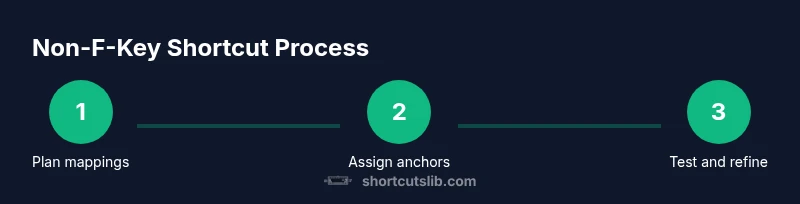
Modifier keys are your most powerful tool for shortcuts. Prioritize combinations that don’t collide with standard OS or app shortcuts. On Windows, Ctrl + a letter is typically a safe default; on macOS, Cmd + a letter pairs are natural for many tasks and align with native conventions. Avoid using numeric keys as primary keys for common actions, because they can interfere with numeric input. Shift can add another layer for advanced tasks, such as multi-step actions or toggles. Remember to test across apps to ensure a consistent experience; a good rule of thumb is to pick one anchor and two or three secondary keys per task.
Platform differences: Windows, macOS, Linux
Windows, macOS, and Linux environments expose different mapping preferences and keystroke expectations. Windows favors Ctrl for most shortcuts; macOS leans on Cmd; Linux varies by desktop environment, but often mirrors Windows or macOS depending on the app. When designing non-F-key shortcuts, document the platform-specific behaviors and provide fallback options. If a shortcut conflicts with a system action on one platform, consider swapping the main key or changing the modifier without changing the task’s mental model. Cross-platform consistency yields a smoother experience during transitions between devices.
Common modifier combos and examples
Here are practical, high-utility patterns you can adopt right away:
- Ctrl/Cmd + C: Copy (universal)
- Ctrl/Cmd + V: Paste (universal)
- Ctrl/Cmd + X: Cut (universal)
- Alt/Option + Arrow: Move focus or tabs
- Ctrl/Cmd + Shift + S: Save As or export
- Ctrl/Cmd + F: Find within docs or pages Every combination should map to a single, predictable action. When introducing a new shortcut, reserve a small, memorable letter cluster that’s easy to recall and doesn’t collide with existing shortcuts in your most-used apps.
How to map shortcuts in popular apps
Mapping shortcuts varies by app, but the core approach remains: locate the keyboard shortcuts section in preferences, add a new binding, then choose a modifier combination and a primary key. In many editors, you can override default bindings; in browsers, you may need extension support. Start with a few essential actions (copy, paste, save) and expand to navigation and formatting. Keep a changelog so teammates can adopt the same conventions.
Testing and refining shortcuts
Testing is essential to ensure reliability. Start by using the shortcuts in a controlled workflow, noting any conflicts or accidental triggers. If a key combination collides with OS commands or other apps, rebind to a different primary key or modifier. Use a simple checklist: does the shortcut trigger correctly in all target apps? Is it easy to remember? Do you experience any misfires under load? Iterate until the set feels natural, uniform, and robust.
Accessibility considerations
Non-F-key shortcuts should be legible and easy to press, even for users with motor challenges. Favor keys that are easy to reach and avoid combinations that require awkward finger stretches. Provide alternative mappings for screen-reader users or those who rely on sticky keys. Document shortcuts clearly and ensure your docs include keyboard diagrams or alt text for quick reference.
Troubleshooting a broken shortcut
If a shortcut stops working, verify the binding still exists and there are no OS-level overrides. Check for app-specific overrides that may reset bindings after updates. Test the same shortcut in a minimal environment (one app, no extensions) to isolate conflicts. If necessary, reset the binding and reapply with a different main key. Keeping a small registry of changes helps prevent regressions.
Advanced patterns: sequences and chords
Beyond single-key bindings, you can design sequences (A → B) or chords (three-key combos) for power users. Sequences work best for multi-step tasks (e.g., open a menu, select an item, confirm). Chords require precise timing, so ensure your OS or app can distinguish between deliberate chords and accidental key presses. Use longer keys for sequences that aren’t frequently used, and reserve quick chords for critical operations to preserve speed and accuracy.
Pro tips for speed and consistency
- Start with a small core set of mappings and expand gradually to avoid cognitive overload.
- Use a consistent anchor (Ctrl/Cmd) across platforms to improve recall.
- Audit bindings periodically to remove conflicts and obsolete mappings.
- Document mappings in a central reference so teammates can adopt a shared standard.
Practical checklist to implement non-F-key shortcuts
- Define 4–6 core actions to map first.
- Pick a stable modifier anchor (Ctrl/Cmd) and 1–2 secondary keys.
- Map consistently across Windows and macOS where possible.
- Test in production apps and across tasks to verify reliability.
- Document changes and create a fallback plan for conflicts.
Tools & Materials
- Computer or laptop(With internet access to consult OS/app docs during setup)
- OS keyboard settings access(macOS System Preferences > Keyboard or Windows Settings > Keyboard)
- Notepad or note-taking app(Record intended mappings and observed conflicts)
- Reference keyboard modifier keys(Know your anchors: Ctrl, Alt/Option, Shift, Cmd)
- Target apps for practice(Text editor, browser, productivity suite)
Steps
Estimated time: 30-45 minutes
- 1
Define your goal
Decide which actions you want quick access to and where you'll map them (OS or application level). Prioritize tasks you perform most often to maximize impact.
Tip: Write down 3–5 essential actions to map first. - 2
Choose a primary key
Select a primary key that won’t trigger conflicts with common shortcuts in your most-used apps. Letters usually work best when combined with modifiers.
Tip: Prefer a letter key from the home row for speed. - 3
Choose your modifier group
Decide on a stable modifier anchor (Ctrl/Cmd) and whether to add Alt/Option or Shift for advanced actions. Keep the pattern consistent across tasks.
Tip: Limit to one or two modifiers to avoid confusion. - 4
Create the binding
In OS or app preferences, map the chosen primary key and modifiers to the action. Use a descriptive name for the binding to ease recall.
Tip: Document the binding in a central reference. - 5
Test the binding
Run through your typical workflow to confirm the shortcut fires reliably and does not conflict with other shortcuts.
Tip: Test under load and in different apps you use daily. - 6
Check for conflicts
Search for overlapping shortcuts at the OS and app level. If conflicts exist, rebind to a different key or modifier.
Tip: Keep a conflict log for future maintenance. - 7
Document and audit
Record each mapping, including platform, app, and rationale. Schedule periodic reviews to adjust for app updates.
Tip: Create a shared cheatsheet for team use. - 8
Roll out and iterate
Introduce bindings to others gradually, collect feedback, and refine mappings based on real-world use.
Tip: Be prepared to sunset mappings that underperform.
Questions & Answers
Can I replace F-key shortcuts in all apps, or are there exceptions?
Most apps support non-F-key shortcuts, but some legacy or specialized software may rely on function keys. In those cases, you can often remap within the app or use OS-level shortcuts as a fallback. Always test in your most-used environments.
Most apps support non-F-key shortcuts, but some may rely on function keys. Test in your environment and use app-level remaps if needed.
What modifiers should I prioritize for cross-platform shortcuts?
A common approach is to use Ctrl on Windows and Cmd on macOS as the primary modifier, with Alt or Shift as secondary modifiers for advanced actions. This aligns with user expectations and reduces confusion.
Use Ctrl on Windows and Cmd on macOS as the main modifier, adding Alt or Shift for extra actions.
How can I avoid conflicts when mapping new shortcuts?
Check existing OS and app shortcuts before binding. If a conflict is found, swap the primary key or adjust the modifier to keep actions distinct and reliable.
Check for conflicts first, then adjust bindings to keep actions distinct.
Do Linux users need different strategies for non-F-key shortcuts?
Linux desktop environments vary, but many map similarly to Windows or macOS. Use a consistent anchor and test across the most-used environments like GNOME or KDE.
Linux shortcuts vary by environment; test across GNOME, KDE, and other setups to stay consistent.
Are there accessibility considerations for non-F-key shortcuts?
Yes. Choose keys that are easy to reach and provide alternatives for users with motor challenges. Include keyboard diagrams and descriptive alt text in guides.
Consider accessibility by choosing easy-to-reach keys and offering alternatives.
How long does it take to establish a solid non-F-key shortcut system?
Expect a few sessions to map, test, and document an initial set. Ongoing refinement based on feedback helps maintain efficiency.
It takes a few sessions to map and test; ongoing refinement keeps it efficient.
Watch Video
Main Points
- Start with a stable modifier anchor (Ctrl/Cmd) and small, memorable primary keys.
- Avoid F-keys to improve cross-app consistency and recall.
- Test thoroughly across platforms and apps before rolling out.
- Document mappings and maintain a central reference for teams.